Abstract
Four feral cats and a raccoon dog purchased from a local collector on Aphaedo Island, Shinan-gun, where human Gymnophalloides seoi infections are known to be prevalent, were examined for their intestinal helminth parasites. From 2 of 4 cats, a total of 310 adult G. seoi specimens were recovered. Other helminths detected in cats included Heterophyes nocens (1,527 specimens), Pygidiopsis summa (131), Stictodora fuscata (4), Acanthotrema felis (2), Spirometra erinacei (15), toxocarids (4), and a hookworm (1). A raccoon dog was found to be infected with a species of echinostome (55), hookworms (7), toxocarids (3), P. summa (3), and S. erinacei (1). No G. seoi was found in the raccoon dog. The results indicate that feral cats and raccoon dogs on Aphaedo are natural definitive hosts for intestinal trematodes and cestodes, including G. seoi, H. nocens, and S. erinacei. It has been first confirmed that cats, a mammalian species other than humans, play the role of a natural definitive host for G. seoi on Aphaedo Island.
-
Key words: Gymnophalloides seoi, Heterophyes nocens, Pygidiopsis summa, intestinal helminth, cat, raccoon dog
Gymnophalloides seoi Lee, Chai and Hong, 1993 (Trematoda: Gymnophallidae) is a minute intestinal fluke of humans and migratory birds, including the palearctic oystercatcher,
Haematopus ostralegus [
1-
4]. Gerbils, hamsters, cats, rats, dogs, ducks, plovers, and several strains of mice were proved to be experimental definitive hosts [
5,
6]. High endemicity of human
G. seoi infection and high infection rate of its metacercariae in oysters,
Crassostrea gigas, were observed on several southwestern islands of the Republic of Korea [
4]. The infection rates of humans and oysters have not been changing significantly even after repeated mass chemotherapy of people in the village with praziquantel [
7]. Therefore, possible existence of natural definitive hosts other than man and oystercatchers has been suggested.
Stray cats or feral cats are nowadays frequently found in almost every place of the Republic of Korea, including coastal areas. They are suggested to be a natural definitive host for G. seoi, since they find foods including de-shelled raw oysters in a waste box or, in some cases, steal seafood in the kitchen of villagers in coastal areas. A raccoon dog with a similar life pattern to cats was also suspected as a source of G.seoi or other parasite eggs.
Heterophyid flukes, in particular
Heterophyes nocens and
Pygidiopsis summa, are another group of intestinal trematodes that infect humans in coastal areas [
8,
9]. The source of human infections is brackish water fish, including the mullet, goby, and perch produced from estuaries [
9]. Cats purchased from a market in Seoul [
10] and in Busan [
11] were found to be infected with
H. nocens and
P. summa. However, no studies have been progressed on the infection status of cats caught in other localities of the Republic of Korea. The present study aimed to investigate the infection status of feral cats and a raccoon dog on Aphaedo Island, Shinan-gun with intestinal helminths. Aphaedo is a well-known endemic area of
G. seoi and
H. nocens infections [
12,
13].
The carcasses of 4 feral cats and a raccoon dog caught on Aphaedo Island by a villager were purchased. It was informed by the villager that the raccoon dog and a cat were obtained in January 2003, and 3 other cats were caught in February 2004. Their intestines were longitudinally opened with a pair of scissors in 0.85% saline and washed with the same solution until the supernatant became clear. The sediment of the intestinal contents was carefully examined for parasites using a stereomicroscope. The collected worms were fixed in 10% neutral formalin solution and identified using a light microscope after acetocarmine stain.
Adult
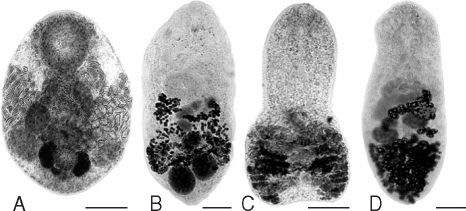
G. seoi were recovered in 2 of 4 cats examined. One cat had 307
G. seoi adults and the other had 3 adults (
Fig. 1;
Table 1). These cats were co-infected with
H. nocens (a total of 1,527 worms in 4 cats) and
P. summa (131). In a raccoon dog, no adults of
G. seoi were collected; however, 55 specimens of echinostomes (species undetermined) were obtained (
Table 1). Other helminths, including toxocarids, hookworms,
Stictodora fuscata,
Acanthotrema felis, and
Spirometra erinacei were also collected from the animals examined.
There had been no studies on intestinal parasites of raccoon dogs in the Republic of Korea. Therefore, this is the first report on intestinal parasites of raccoon dogs. As for cats, infections with several helminth species, i.e.,
Clonorchis sinensis,
Paragonimus westermani,
H. nocens,
Metagonimus yokogawai,
P. summa,
Stellantchasmus falcatus,
Heterophyopsis continua,
Centrocestus sp.,
Echinochasmus perfoliatus,
Echinoparyphium sp.,
A. felis,
Pharyngostomum cordatum,
S. erinacei,
Taenia taeniaeformis,
Anisakis simplex (larva), and
Toxocara cati, have been reported [
14-
16]. In addition, an experimental study showed that cats were a fairly suitable host for
G. seoi infection compared with ducks, chicks, and 6 kinds of mammals, including gerbils, hamsters, rats, dogs, guinea pigs, and mice [
5]. The present study first demonstrates that feral cats are a natural definitive host for
G. seoi infection. However, the epidemiological significance of feral cats in maintaining the endemicity in the surveyed area needs to be further clarified.
It is of note that infection of a clam with metacercariae of a gymnophallid,
Meiogymnophallus fossarum, could change their host's orientation, behavior, and distribution [
17,
18]. The infected clams could be more easily visible in the sand substrate by the definitive host than non-parasitized clams, thus could facilitate predation. Oysters infected with metacercariae of
G. seoi could be exposed more easily to oystercatchers or other definitive hosts, although this speculation has not been confirmed. It is well accepted that oystercatchers have the natural capacity of destroying oyster shells and eating the animal part. However, it is questioned how cats can open the shell of an oyster and consume the animal part. A possible explanation is that they may have consumed the wasted animal part of oysters, since stray or feral cats could easily find wasted oysters discarded in the trash box or in the yard in endemic areas.
ACKNOWLEDGEMENTS
This study was supported by BK21 Human Life Sciences, Ministry of Education, Republic of Korea.
References
Fig. 1Intestinal flukes recovered from feral cats caught on Aphaedo Island, Shinan-gun, Jeollanam-do, a known endemic area of Gymnophalloides seoi. (A) G. seoi adult. Bar = 0.07 mm. (B) Heterophyes nocens adult. Bar = 0.1 mm. (C) Pygidiopsis summa adult. Bar = 0.1 mm. (D) Stictodora fuscata adult. Bar = 0.1 mm.

Table 1.Infection status of intestinal parasites in feral cats and a raccoon dog collected from Aphaedo Island, Shinan-gun
Table 1.
|
Parasite |
No. of worms collected from
|
|
Raccoon dog |
Feral cats
|
|
A |
B |
C |
D |
|
Gymnophalloides seoi
|
0 |
3 |
0 |
0 |
307 |
|
Heterophyes nocens
|
0 |
725 |
686 |
18 |
98 |
|
Pygidiopsis summa
|
3 |
20 |
39 |
11 |
61 |
|
Stictodora fuscata
|
0 |
0 |
0 |
0 |
4 |
|
Acanthotrema felis
|
0 |
0 |
0 |
0 |
2 |
|
Echinostomesa
|
55 |
0 |
0 |
0 |
0 |
|
Spirometra erinacei
|
1 |
5 |
1 |
1 |
8 |
|
Toxocaridsa
|
3 |
2 |
1 |
0 |
1 |
|
Hookwormsa
|
7 |
0 |
0 |
0 |
1 |
|
Total |
69 |
755 |
727 |
30 |
482 |
Citations
Citations to this article as recorded by

- Metabarcoding of pathogenic parasites based on copro-DNA analysis of wild animals in South Korea
Jun Ho Choi, Soo Lim Kim, Dong Kyun Yoo, Myung-hee Yi, Singeun Oh, Myungjun Kim, Sohyeon Yun, Tai-Soon Yong, Seongjun Choe, Jong Koo Lee, Ju Yeong Kim
Heliyon.2024; 10(9): e30059. CrossRef - Parvatrema duboisi (Digenea: Gymnophallidae) Life Cycle Stages in Manila Clams, Ruditapes philippinarum, from Aphae-do (Island), Shinan-gun, Korea
Bong-Kwang Jung, Taehee Chang, Hyejoo Shin, Seungwan Ryoo, Sooji Hong, Jeonggyu Lee, Hyemi Song, Jaeeun Cho, Deok-Gyu Kim, Hojong Jun, Min-Jae Kim, Eun Jeong Won, Eun-Taek Han, Eun-Hee Shin, Jong-Yil Chai
The Korean Journal of Parasitology.2021; 59(1): 83. CrossRef - Euryhelmis squamula (Digenea: Heterophyidae) Recovered from Korean Raccoon Dog, Nyctereutes procyonoides koreensis, in Korea
Hyeon Cheol Kim, Eui Ju Hong, Si Yun Ryu, Jinho Park, Jeong Gon Cho, Do Hyeon Yu, Joon Seok Chae, Kyoung Seong Choi, Bae Keun Park
The Korean Journal of Parasitology.2021; 59(3): 303. CrossRef - Cryptocotyle lata (Trematoda: Heterophyidae) Adult from a Korean Raccoon Dog, Nyctereutes procyonoides koreensis
Heon Woo Lee, Eui Ju Hong, Hyeon Cheol Kim, Si Yun Ryu, Bae Keun Park
The Korean Journal of Parasitology.2021; 59(6): 645. CrossRef - Foodborne intestinal flukes: A brief review of epidemiology and geographical distribution
Jong-Yil Chai, Bong-Kwang Jung
Acta Tropica.2020; 201: 105210. CrossRef - Morphological and Molecular Confirmation of Parvatrema duboisi Metacercariae in the Manila Clam Ruditapes philippinarum from Gochang-gun, Korea
Taehee Chang, Bong-Kwang Jung, Hyejoo Shin, Sooji Hong, Jeonggyu Lee, Deok-Gyu Kim, Laddawan Patarwut, Woon-Mok Sohn, Jong-Yil Chai
The Korean Journal of Parasitology.2020; 58(1): 87. CrossRef - Necrotizing Enteritis Caused by Pharyngostomum cordatum Infection in a Stray Cat
Ji-Hyeon Kim, Kyunghyun Lee, Woon-Mok Sohn, Ha-Young Kim, Yu-Ran Lee, Eun-Jin Choi, ByungJae So, Ji-Youl Jung
The Korean Journal of Parasitology.2019; 57(1): 17. CrossRef - A case report on the gallbladder fluke, Euparadistomum herpestesi (Trematoda: Dicrocoeliidae), in stray cats (Felis catus) in Beni-Suef, Egypt
Khaled Mohamed El-Dakhly, Amany Samir Aboshinaf, Asmaa Alaa Kamel
Journal of Parasitic Diseases.2018; 42(4): 646. CrossRef - Morphological and Molecular Characterization of Toxocara tanuki (Nematoda: Ascaridae) from Korean Raccoon Dog, Nyctereutes procyonoides koreensis
Umanets Alexander, Chae-Wong Lim, Bumseok Kim, Eui-Ju Hong, Hyeon-Cheol Kim, Bae-Keun Park
The Korean Journal of Parasitology.2018; 56(6): 567. CrossRef - Fishborne zoonotic heterophyid infections: An update
Jong-Yil Chai, Bong-Kwang Jung
Food and Waterborne Parasitology.2017; 8-9: 33. CrossRef - Human sparganosis, a neglected food borne zoonosis
Quan Liu, Ming-Wei Li, Ze-Dong Wang, Guang-Hui Zhao, Xing-Quan Zhu
The Lancet Infectious Diseases.2015; 15(10): 1226. CrossRef - Four Human Cases of Acanthotrema felis (Digenea: Heterophyidae) Infection in Korea
Jong-Yil Chai, Jae-Lip Kim, Min Seo
The Korean Journal of Parasitology.2014; 52(3): 291. CrossRef - Trematodes Recovered in the Small Intestine of Stray Cats in the Republic of Korea
Jong-Yil Chai, Young Yil Bahk, Woon-Mok Sohn
The Korean Journal of Parasitology.2013; 51(1): 99. CrossRef - DETECTION OF GASTROINTESTINAL PARASITES IN RACCOON DOGS (NYCTEREUTES PROCYONOIDES) IN THE SEOSAN RECLAIMED LANDS, KOREA
Kyung-Yeon Eo, Dongmi Kwak, Oh-Deog Kwon
Journal of Zoo and Wildlife Medicine.2012; 43(3): 682. CrossRef - Foodborne Intestinal Flukes in Southeast Asia
Jong-Yil Chai, Eun-Hee Shin, Soon-Hyung Lee, Han-Jong Rim
The Korean Journal of Parasitology.2009; 47(Suppl): S69. CrossRef