Abstract
House-residual spraying and insecticide-treated bed nets have achieved some success in controlling anthropophilic and endophagic vectors. However, these methods have relatively low efficacy in Korea because Anopheles sinensis, the primary malaria vector, is highly zoophilic and exophilic. So, we focused our vector control efforts within livestock enclosures using ultraviolet black light traps as a mechanical control measure. We found that black light traps captured significantly more mosquitoes at 2 and 2.5 m above the ground (P < 0.05). We also evaluated the effectiveness of trap spacing within the livestock enclosure. In general, traps spaced between 4 and 7 m apart captured mosquitoes more efficiently than those spaced closer together (P > 0.05). Based on these findings, we concluded that each black light trap in the livestock enclosures killed 7,586 female mosquitoes per trap per night during the peak mosquito season (July-August). In May-August 2003, additional concurrent field trials were conducted in Ganghwa county. We got 74.9% reduction (P < 0.05) of An. sinensis in human dwellings and 61.5% reduction (P > 0.05) in the livestock enclosures. The black light trap operation in the livestock enclosures proved to be an effective control method and should be incorporated into existing control strategies in developed countries.
-
Key words: Anopheles, mosquito, malaria, vector control, ultraviolet black light trap, zoophilic vector
INTRODUCTION
In the Republic of Korea (ROK), malaria vector control is generally conducted during the summer season (from May to October) using hand held or truck mounted thermal fogging, wearing of insecticide-impregnated clothing, and residual spray on the outdoor walls and resting places. These classic vector control techniques prove to be time and resource intensive. Likewise, resting areas of
Anopheles are widely dispersed and difficult to find. Insecticide space spraying also kills non-target insects and fails to provide lasting protection from continuously emerging mosquitoes from breeding places. Furthermore, engorged mosquitoes show less susceptibility to insecticides [
1].
Livestock density is known to be a major factor to influence mosquito populations [
2,
3]. Bouma and Rowland [
4] have shown strong positive correlations between the cattle to human ratios and malaria incidence. Because cattle are known as a dominant blood source of
Anopheles sinensis in Korea [
5,
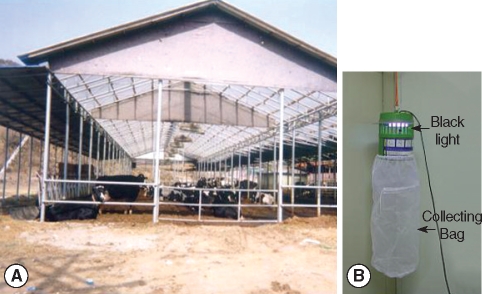
6], it follows that if we can effectively block mosquitoes feeding on cattle, subsequent numbers of malaria cases would decrease due to lowering of the mosquito to human contact rate. In the ROK, most cattle are reared and fed in small enclosures, not on pastureland. Most cattle enclosures have only simple metal or plastic sheet roofs and do not have any walls (
Fig. 1A). Sleeping livestock are defenseless to mosquitoes and other blood-sucking insects. To block mosquito feeding, several researchers have evaluated pyrethroid insecticide sprayed directly on the cattle [
3,
7]. For this topical application, we must verify that these direct applications are not affecting milk or meat safety and its quality. In addition, mosquitoes cannot easily enter into human dwellings at night in Korea because of completely enclosed structure (e.g. no roof gaps and screened windows and doors). Households commonly use slow burning insecticides (e.g. insecticide vaporizers) when they sleep. Fortunately,
An. sinensis shows peak biting activity after 22:00 hr [
8], when most people are sleeping in their bedrooms. For these reasons, the use of insecticide impregnated bed-nets and indoor-residual sprays, which are traditional and popular methods to minimize vector-human contact rate in the tropical malaria endemic areas, are less useful in Korea.
To develop new vector control methods that are appropriate for developed countries, we concentrated our efforts on the primary blood meal sources (livestock enclosures), where there are high densities of female mosquitoes. When we collected mosquitoes in livestock enclosures, we found engorged mosquitoes were highly attracted to black light traps (personal experience). Even though this method is not effective at reducing the mosquito-cattle contact rate, this is the best way to kill the blood fed female mosquitoes that ultimately results in decreasing the population size of larvae and adult mosquitoes. If electrical power is available, this method can be used nightly throughout the whole mosquito season. In this study, we evaluated the effectiveness of this economic and environmentally benign technique, operating black light traps in livestock enclosure, to reduce mosquito populations in an endemic area of malaria.
MATERIALS AND METHODS
Study area
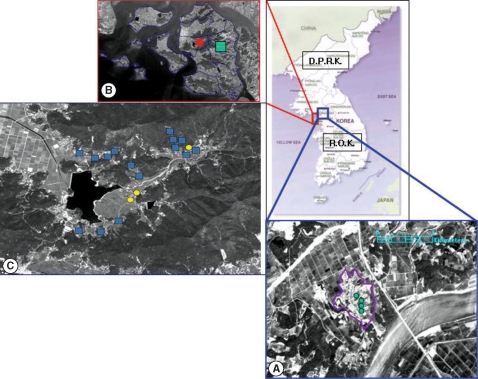
For this study, we chose 2 locations of malaria endemic areas. For the trap height, spacing evaluation, and trap effectiveness, we chose Paju county (
Fig. 2B), Gyeonggi-do (province), having 1,314 vivax malaria cases during 1993-2003. Conversely, for the trap efficacy in field trials, we selected operating and non-operating sites in Ganghwa county, Inchon city, located west of Seoul and had 794 vivax malaria cases during 1993-2003. This island county has a high mountain at the center to serve as a natural barrier against mosquito migration (
Fig. 2C) from outside of operated area.
The ROK commonly uses an electric mechanical light trap called a "Nozawa trap" that has characteristics of both CDC style miniatures and New Jersey light trap. The Nozawa trap (
Fig. 1B) typically incorporates two 4-watt fluorescent ultraviolet lamps (ca. 420 nm) with a trap body cylinder that measures 17 × 11 cm. Within the plastic trap body cylinder, there is a 7 cm fan with electric motor and sucks attracted mosquitoes into a replaceable collection bag. The entrance to the cylinder was covered with a wire mesh screen (8 meshes) to exclude larger non-target insects such as moths and beetles. It has a wider gap (about 2 cm) between the fan blades and edge of the trap body cylinder to minimize being slowed or stopped due to the accumulation of destroyed engorged females and bovine blood.
In order to evaluate the most effective trap height in the livestock enclosures, we used 5 traps suspended at 0.5, 1, and 2 m above ground level (AGL). Trap collections were made every hour from 20:00 to 23:00 hr. To evaluate additional trap heights, we conducted additional replications using 1.5, 2, and 2.5 m AGL operated in the same manner. Mosquitoes were anesthetized using chloroform and then counted and identified using the key developed by Lee [
9]. Trap collections were log transformed {log (x + 1)} and analyzed using 1-way ANOVA. Multiple comparisons were conducted using Tukey's multiple range tests [
10].
In order to evaluate the most effective distance between traps and minimize the number of traps used in each livestock enclosure, we spaced traps at 1, 2, 3, 4, and 7 m distances apart from each other. We conducted these tests from 24 July to 2 August 2001 with all traps set at 2.5 m AGL. To decrease sampling bias, we altered the trap position at every trapping hour.
BLT effectiveness
To evaluate the overall numbers of mosquitoes collected during the mosquito season, we selected 4 livestock enclosures (
Fig. 2B) in Paju county. Each livestock enclosure contained 70 to 100 heads of cattle and operated 4-6 Nozawa traps. Traps were placed at 5 m intervals at 2.5 m AGL and operated at every monday from May to September 2002. Because of the large volume of mosquitoes in each collection bag, we estimated the number of mosquitoes based on their weight. After discarding large nontarget insects, the mosquitoes were placed in a drying oven (65℃ for 24 hr) and then weighed. Approximately 10% of collected mosquitoes was counted and identified.
In order to determine the suppression of mosquito population with BLTs operating in livestock enclosures, we conducted field trials in Ganghwa county from the last week of May through the second week of August 2003. The operating area was surrounded by mountains that presumably help limit mosquito migration. The control area is located on the east side of the mountains. We operated the BLTs at all of the livestock enclosures in the operated area (
Table 1;
Fig. 2C). The number of traps at each livestock enclosure was decided based upon the farm size. Traps were daily operated by the farm owners following our guidelines and maintained weekly by ourselves. In order to compare the capacity of mosquito producing between the operated and control areas, we operated BLT in 2 days a week for 3 wk before initiating operation. Actual evaluation began at the 2nd week of June, prior to begin regular mosquito production season.
To monitor the mosquito control effects, we chose 3 houses and 1 cowshed in the operated area. However, the control area had 2 checkpoints, 1 house and 1 cowshed. BLT was operated 2 times a week with the same style of trap with livestock farms from 18:00 to 06:00 hr. Traps were placed at 2.5 m AGL near the bedroom windows, helping attract mosquitoes with the breath of sleeping humans. Mosquitoes were processed as described in the previous section and identified. A trap index (no. of female mosquitoes per trap per night) was calculated based on the sum of mosquitoes divided by the number of traps. Percent reduction of vector density was calculated using the following formula as under described [
11,
12]:
Percent reduction = 100 - C1/T1 × T2/C2 × 100
Where C1 = Pre-operating mosquito density in the control area, C2 = Post-operating mosquito density in the control area, T1 = Pre-operating mosquito density in the operated area, T2 = Post-operating mosquito density in the operated area. Statistical methods comparing mosquito densities employed univariate analysis of variance (2-way ANOVA) [
10] on log-transformed data.
RESULTS
BLT sampling height
Of the traps placed 0.5, 1, and 2 m above the ground, significantly larger collections were consistently found at 2 m (
P < 0.01) from 20:00 to 23:00 hr for four trap nights (
Table 2). Due to the initial success of mosquitoes being captured in UV traps set at 2 m, additional tests were conducted to evaluate the effectiveness of UV traps set at greater than 2 m above the ground. The additional tests include traps set at 1.5, 2, and 2.5 m. In the latter, traps at 2.5 m captured significantly more (
P = 0.01) mosquitoes than the other trap heights. Traps could not be placed at more higher above the ground because of the height of the livestock enclosure and effectiveness of maintenance. Of those hourly sampling times evaluated, there was no significant difference (
P = 0.225) in the numbers of mosquitoes collected in either trial.
Although statistically significant differences (
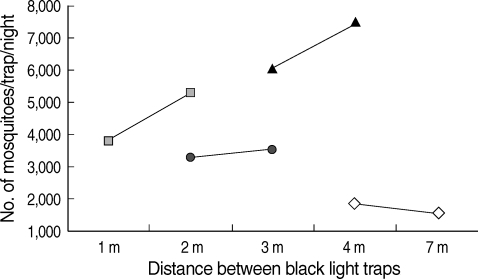
P > 0.05) were not noted for any of the trap separating combinations (1, 2, 3, 4, and 7 m spacing), in general, mosquitoes were more captured at the wider spacing (
Fig. 3) except 4 and 7 m spacing combination. There were 2,030 mosquitoes collected in 4 m spacing. However, 1,722 mosquitoes were collected in 7 m spacing, an opposite result with other spacing combinations. We concluded that the appropriate interval of the black light trap to get high efficacy is between 4 to 7 m spacing.
A total of 1,284,519 mosquitoes (85,635 mosquitoes/night) were collected from May to August with 15-18 black light traps per night in 4 livestock enclosures. Of the total, 43,931
Anopheles mosquitoes per night constituted 51.3% of the total mosquito collection. The number of total mosquitoes collected by each BLT for a day was 5,037/trap/night, including 2,584
Anopheles (
Table 3). During the seasonal peak of mosquito population (July to August), 1 BLT captured a high of 7,586 mosquitoes/trap/night. Because we operated about 17 traps per night during the sampling period, an average of about 130,000 adult female mosquitoes, mostly blood fed, was killed every day using the BLTs in this particular study area.
The mosquito population density in the operated and non-operated areas was shown in
Table 4 and
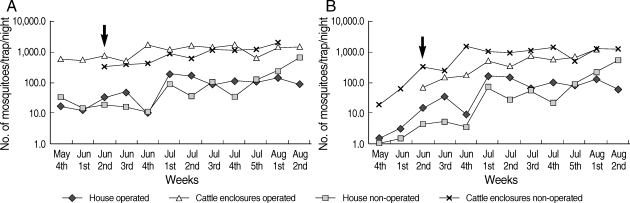
Fig. 4. During the pre-operating periods, the operated area showed 2 times higher trap index (individuals per trap per night) for the total number of mosquitoes captured in the traps placed near human dwellings. However, in the post-operating period, trap indices for total mosquitoes in both operated and non-operated areas were similar (
Fig. 4). Based on these results, we calculated a 39.6% reduction in mosquitoes near the human dwellings. Moreover, this method showed a 2-fold higher reduction (74.9%) in
An. sinensis, the primary malaria vector in Korea. In the livestock enclosure areas, we found a similar pattern of reduction. The total number of mosquitoes was reduced by about 40% with
An. sinensis reduced by 61.5%. Overall, we found BLT operation in the livestock enclosures to be a useful and effective method to control mosquitoes and malaria vector population. Two-way ANOVA found a significant reduction in
Anopheles mosquitoes (
P = 0.047) and for the total number of mosquitoes near the human dwellings (
P = 0.019). However, we did not find any statistical difference for the number of mosquitoes in the livestock enclosures (
P > 0.05).
DISCUSSION
House-residual spraying and insecticide-treated net are popular methods for malaria vector control around the developing world. These interventions have been most successful against predominantly anthropophilic and endophagic vectors. However, if malaria vectors are exophilic and zoophilic like An. sinensis, these traditional control methods would be less effective. To develop a new strategy for vector control, we employed black light traps to collect and kill engorged female mosquitoes in the livestock. We presume that if we attract and kill large numbers of engorged female mosquitoes, it could be a significant adverse effect on its reproductive success by reducing larval production and eventually decrease the overall mosquito population in an endemic area of malaria. A CDC style miniature trap is not proper to use in the livestock enclosures because of the narrow influx hole. When an engorged mosquito passed with fan, it could burst and accumulate at the side and eventually stuck fan-blade. However, The Nozawa style BLT has a powerful motor assembly and a relative position of mechanical components that prevents fouling and malfunctions due to large numbers of blood-engorged females.
During our trap height evaluations (0.5, 1, 1.5, 2, and 2.5 m) in the livestock enclosures (
Table 2), most mosquitoes were caught at the higher installation height (2 and 2.5 m), which is the opposite result with open areas [
13]. The increased effectiveness of BLTs placed at greater heights is likely due to increased visibility to wide range. The difference between flying height in open outdoor areas versus the confines of the livestock enclosure is assumed to relate with their host finding mechanism. In order to follow a host odor, mosquitoes prefer to fly at lower heights in open areas because it is not disturbed by wind or other environmental variables. In the livestock enclosures, however, mosquitoes are more likely to use visual cues and stimuli to find hosts instead of long-range chemical sensors like antenna [
14]. Based on 2.5 m of the installation height of the trap, traps were installed with 1, 2, 3, 4, and 7 m spacing. We hypothesized that the attraction area of narrow spacing among traps should decrease and reduce the trap efficacy because of too much overlapping of attraction area with other traps. On the other hand, if the traps were installed too wide, both traps did not cover the whole area leaving some missing areas. Even though we did not find any significant difference between spacing, we caught more mosquitoes according to wider intervals except between 4 and 7 m spacing combination (
Fig. 3). Therefore, we concluded that 4-7 m spacing is a reasonable institutional interval to establish black light traps in the livestock enclosures for vector control because that spacing should perfectly cover the whole area.
Even though we altered the trap position at each trapping hour to diminish the bias of trap position, the first trapping hour (21: 00 to 22:00 hr) showed a much higher amount of mosquitoes than the 2nd period (22:00 to 23:00 hr) in all spacing replications. This is related with the distance from the animals to trap. During the second operating hour, most livestock moved out to the backyard, which does not have any roof. From this phenomenon, we found that this method is to be well fitted in the livestock farm to confine to a small place without moving a cow. The distance between the trap and cow is the most important factor to decide the effectiveness of the catching rate of the BLT.
Based on the previous results, BLTs were established in all the cowsheds in the Paekyeon-ri, Paju county. Every trap caught and killed 7,586 blood fed mosquitoes every day during the summer season. If we try to convert this result to completely operating days and number of BLTs and considering 1 blood fed An. sinensis female lays an average of about 200 eggs per gonotrophic cycle, the BLT should continuously help suppress the numbers in the next generation of mosquitoes, and should eventually decreases the overall mosquito population.
In a developing country, scientists [
3,
7,
15] have evaluated insecticide treatment to cattle or livestock. This is an alternative method to control the exophilic and zoophilic malaria vector. Rowland et al. [
7] showed that the mean milk yield of deltamethrin treated cow did not decrease. On the other hand, non-treated cows fell by 11% during the malaria transmission season. Despite these results, we have to check the residual insecticide in the milk and their meat. In addition, engorged mosquito showed less mortality than unfed ones, which stayed on the animal and rested on the wall [
2]. However, the BLT did not mention the gorged situation of mosquitoes catching and killing. It attracted and caught more engorged mosquitoes (personal experience) than unfed.
Thermal fogging is one of the most popular vector control methods in Korea. The health center sprayed it 2-3 times a week before 22:00 hr. We cannot exactly count how many mosquitoes were killed by the space spraying. However, fogging time is different with main activity hour of
Anopheles as 00:00 to 03: 00 hr [
6] and the residual effect of fogging is not so long. In addition, we cannot spray insecticide every day because of the limitation of resources and environmental damage. Considering these defects, we convinced that a BLT does not fall far behind the normal spray method in the vector control effects. Moreover, thermal fogging can lead to abortion in a cow because of the deafening noise. Moreover, an ultra low volume (ULV) method does not have as much noise but is more dangerous to induce insecticide toxicities. Because of these reasons, the Public Health Center or livestock owners cannot easily apply space spraying in the animal shelters. However, a BLT does not make any noise, any limitation to operating, and any damage to livestock and environment. Only one thing to consider is that if the cattle reach the trap and eat the collecting bags with the mosquitoes, it could cause stomach problems (no evidence). To solve this problem, we have to place the trap at enough distance away from the animals. This would make the trap decrease catching-efficacy. To make a more efficient catching rate as well as protection of the animals, we need to develop the design of the collection bag to place the trap near the animals. If we can attach a wire screen over the influx hole (entrance) of BLT, we can minimize the entering of larger insect as moth and other beneficial insects into the collection bag. In addition, insecticide spray on the cattle or in the blood source should be inducing behavioral resistance to the mosquitoes such as residual spray on the wall [
16].
In the field trial, we settled 59 traps in the operated area. Each livestock shelter had an average of 4 traps and operated everyday during the summer season. House showed a significant reduction of mosquito population. Especially the malaria vector,
An. sinensis, showed a higher control effect than other mosquito species (
Table 4). Using this method, we can suppress 80% of malaria vector produced in the operated area. If the malaria vector is highly zoophilic and exophilic, vector control on the livestock enclosures with a BLT will have more effects than traditional control methods like space sprays, indoor residual sprays, and insecticide-impregnated bed nets. If the cowshed has a good supply of electricity, this method is highly cost-effective to suppress malaria vector population and is not damaging to cows or their environment.
ACKNOWLEDGEMENTS
We wish to acknowledge Dr. Hae Wol Cho (former director of National Institute of Health in Korea), whose support was instrumental in conducting this research. We also appreciate the efforts of Kum Nam Lee, Jung Sook Lee, Chang Whan Na, and Gil Ja Huh in the Paju Public Health Center and Soo Jung Kwon, Jung Jae Kim, and Oh Jun Kwon in the KangWha Public Health Center whose valuable help made this study possible. This work was funded by WHO-RBM (Roll Back Malaria) and National Institute of Health, Korea.
References
Fig. 1Typical livestock enclosure (A) and "Nozawa" style black light (UV) trap (B).

Fig. 2Study sites. (A) Paju county study site with dots showing location of livestock enclosures for trap effectiveness test, 2002. (B) Ganghwa county study site with dots showing operated areas and squares showing control area for field efficacy, 2003. (C) Graphical depiction of BLTs in operated areas, Ganghwa county. Circles show location of traps used as monitoring of the population of mosquito and squares represent location of livestock enclosures, which were operated traps for vector control.
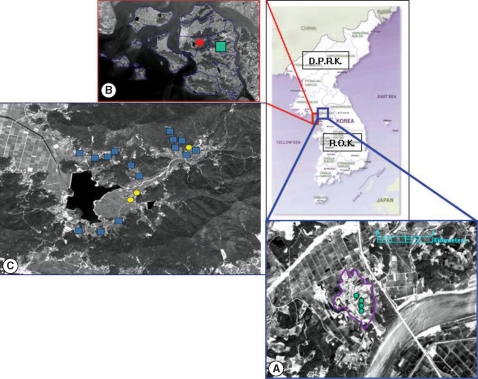
Fig. 3Mean number of mosquitoes captured per trap per night using different spacing combinations (1, 2, 3, 4, and 7 m). Traps were operated from 22:00 to 01:00 hr for 4 trap nights from 24 July to 2 August 2001. All traps were operated at 2.5 m above the ground. The square symbol shows 1 m and 2 m spacing combination at 1st day. Each symbol means different spacing combination at another day.

Fig. 4Seasonal prevalence of mosquitoes in human dwellings and livestock enclosures (A: No. of mosquitoes, B: No. of anopheline mosquitoes). Arrows show the date of starting to operate traps in the operated livestock enclosures. 'Operated' means the area where BLT was operated at the livestock enclosures to the vector control. 'Control' means the area where BLT was not operated at the livestock enclosures to compare the vector control effects.
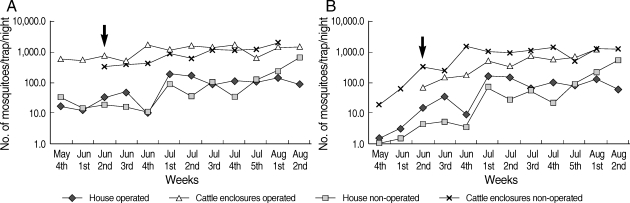
Table 1.The number of traps used in operated areas, and the number and breed of livestock
Table 1.
|
ID |
No. of black light traps |
Species of breed |
No. of animals |
|
1 |
5 |
Beef cattle |
70 |
|
2 |
3 |
Korean beef cattle |
8 |
|
3 |
2 |
// |
8 |
|
4 |
10 |
Beef cattle |
280 |
|
5 |
2 |
Korean beef cattle |
10 |
|
6 |
5 |
Beef cattle |
80 |
|
7 |
5 |
// |
100 |
|
8 |
6 |
// |
50 |
|
9 |
7 |
// |
100 |
|
10 |
5 |
Pig |
250 |
|
11 |
4 |
Beef cattle |
60 |
|
12 |
2 |
Korean beef cattle |
50 |
|
13 |
1 |
// |
4 |
|
14 |
1 |
// |
6 |
|
15 |
1 |
// |
6 |
|
Total |
59 |
|
1,082 |
Table 2.Log-transformed mean number (log x + 1) of female mosquitoes captured in UV traps at different sampling heights at livestock enclosure in July 2001
Table 2.
|
Trap height |
No. of collection |
No. of mosquitoes/trapa
|
Std. Errb
|
Tukey’s testc
|
No. of Anopheles/trapa
|
Std. Errb
|
Tukey’s testc
|
|
Test A |
|
|
|
|
|
|
|
|
0.5 m |
24 |
2.78 |
0.09 |
a |
2.15 |
0.07 |
a |
|
1 m |
24 |
3.01 |
0.08 |
a |
2.40 |
0.05 |
b |
|
2 m |
12 |
3.46 |
0.15 |
b |
2.91 |
0.14 |
c |
|
Test B |
|
|
|
|
|
|
|
|
1.5 m |
2 |
3.27 |
0.02 |
a |
3.00 |
0.04 |
a |
|
2 m |
2 |
3.45 |
0.03 |
b |
3.11 |
0.01 |
a |
|
2.5 m |
2 |
3.91 |
0.01 |
c |
3.73 |
0.05 |
b |
Table 3.The total number of mosquitoes collected by black light traps in livestock enclosures in Paju county, Gyeonggi-do, Korea in 2002
Table 3.
|
Period |
No. of Mosquitoes |
No. of Anopheles
|
No. of operated traps |
|
May to Aug (15 wk) |
|
|
|
|
Total |
1,284,519 |
658,969 |
255 |
|
Avg/trap/night |
5,037 |
2,584 |
|
|
July to Aug (8 wk) |
|
|
|
|
Total |
1,031,653 |
570,897 |
136 |
|
Avg/trap/night |
7,586 |
4,198 |
|
Table 4.Effects of black light trap on reduction of mosquito densities at Ganghwa county, Gyeonggi Do, Korea in 2003
Table 4.
|
Areas |
Average no. of mosquitoes
|
Average no. of Anopheles
|
|
Pre-operate |
Post-operate |
Reduction (%)a
|
Pb
|
Pre-operate |
Post-operate |
Reduction (%)a
|
Pb
|
|
House |
|
|
|
|
|
|
|
|
|
Operatedc
|
21.7 |
113.3 |
39.6 |
0.019 |
9.5 |
96.1 |
74.9 |
0.047 |
|
Control |
16.5 |
142.6 |
|
|
3.0 |
121.4 |
|
|
|
Cowshed |
|
|
|
|
|
|
|
|
|
Operatedc
|
761.5 |
1,284.5 |
40.2 |
0.206 |
330.5 |
1,089.2 |
61.5 |
0.177 |
|
Control |
330.0 |
930.0 |
|
|
68.0 |
581.9 |
|
|