Abstract
In order to determine the current infection status of pond smelts, Hypomesus olidus, and other freshwater fishes with trematode metacercariae, a total of 4,861 pond smelts and 18 other freshwater fishes, collected from the Soyang and Uiam Lakes in Gangwon-do, the Unam Lake in Jeollabuk-do, the Jangseong Lake in Jeollanam-do, the Uirim-ji (lake) in Chungcheongbuk-do, and the Andong Lake in Gyeongsangbuk-do, were individually digested with 1% pepsin-HCl and examined under a dissecting microscope. In all pond smelts caught from the 6 lakes, we were unable to detect any known human infectious trematode metacercariae in Korea. However, in other freshwater fishes, such as, Squalidus japonicus coreanus (Unam Lake), and Zacco platypus (Jangseong Lake) and Opsariichthys uncirostris amurensis (Jangseong Lake), metacercariae of human-infecting trematodes, i.e., Clonorchis sinensis and Metagonimus sp. were detected, respectively.
-
Key words: Hypomesus olidus, pond smelt, Clonorchis sinensis, Metagonimus sp., trematode metacercaria
A few surveys for human-infecting trematode metacercariae in freshwater fishes have been reported several times in Korea (
Chun, 1962;
Rhee et al., 1984;
Kong and Choi, 1994;
Sohn, 2002). The pond smelt (
Hypomesus olidus), which is one of the fish most frequently consumed raw, particularly during the winter season functions, as a source of infection for several trematodes of humans, including
Clonorchis sinensis (
Nam and Sohn, 2000;
Park et al., 2004) in Korea.
The numbers and localities of lakes investigated in previous studies, however, have been quite limited, and the rates of trematode metacercarial infection in fish have varied considerably. Therefore, a clear necessity exists for the large-scale determination of trematode metacercarial infections in pond smelts. In this study, we evaluated the infection status of pond smelts and other freshwater fishes caught in 6 lakes, including the Soyang Lake, a popular locale for icefishing festivals (
Fig. 1).
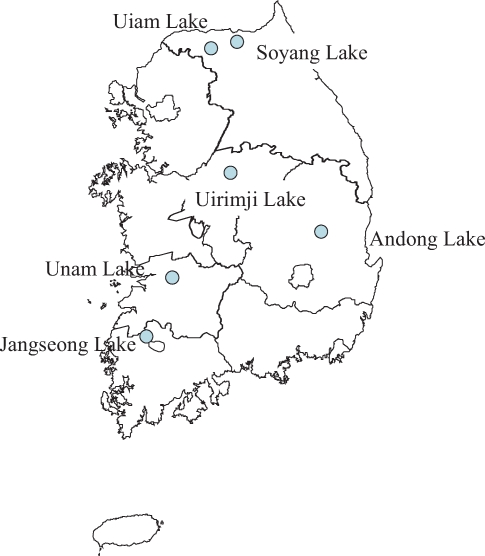
A total of 4,861 pond smelts were collected between January 2003 and February 2005 from the Soyang and Uiam Lakes in Gangwon-do (3,920 and 56 fish, respectively), the Unam Lake in Jeollabuk-do (300), the Jangseong Lake in Jeollanam-do (200), the Uirimji Lake in Chungcheongbuk-do (185) and the Andong Lake in Gyeongsangbuk-do (200) (
Fig. 2) (
Table 1). In addition, 18 other freshwater fishes were collected. The fishes were transported to the laboratory at a temperature of 4℃. After species identification and length and weight measurement, the fishes were individually evaluated for the presence of metacercariae. The fishes were ground with a mortar and pestle, and digested with 1% pepsin-HCl at 37℃ for 2 hr, after which the liquefied specimens were passed through 1 × 1 mm mesh sieves, washed in 0.85% saline, and examined under a stereomicroscope.
Among the 4,861 pond smelts collected from 6 lakes, we were unable to find any metacercariae of human-infectious trematodes (
Table 2). A few metacercariae of
Diplostomum sp. were detected in pond smelts caught from the Jangseong Lake. Contrarily, in other freshwater fishes, such as,
Squalidus japonicus coreanus (Unam Lake), and
Zacco platypus and
Opsariichthys uncirostris amurensis (Jangseong Lake), metacercariae of human-infecting trematodes, i.e., C. sinensis and
Metagonimus sp. were detected, respectively (
Table 2).
The present results evidenced no presence of human-infecting trematode metacercariae in muscles of 4,861 pond smelts, collected from 6 lakes throughout Korea. This result is contrasting to previous studies which demonstrated that pond smelts caught in the Soyang Lake were infected with metacercariae of
C. sinensis (
Nam and Sohn, 2000;
Park et al., 2004). Although seasonal variations in fishing sometimes affect the infection rate of fish with regard to
C. sinensis metacercariae (
Kang et al., 1985;
Kim et al., 1979;
Sohn, 2002), it does not appear to have influenced the results of this study, as the fish were collected between December and March, coinciding with the collection period adopted in previous reports.
The Soyang Lake, the basin of which covers parts of Inje-gun, Yanggu-gun and Hongcheon-gun of Gangwon-do, as well as Chuncheon-shi, is the largest lake in Korea by volume, with a storage capacity of 2,900 × 10
6m
3 of water. Reaching 118 m at its deepest point, and containing relatively clean and cold water, this lake is well-known as one of the major breeding places for pond smelts. Located in the northeastern region of South Korea, the rate of
C. sinensis infection of people living in the surrounds of the basin of the lake is quite low, and the infection rate of fish caught in the lake, with regard specifically to
C. sinensis metacercariae is also quite low (
Korea Centers for Disease Control and Prevention and Korea Association of Health Promotion, 2004;
Nam and Sohn, 2000).
Fish species of the genus
Hypomesus prefer cold water, and are relatively tolerant to pollution, salinity, and temperature fluctuations (
Sato, 1951). Two species of smelts, the pond smelt,
H. olidus, and the Japanese smelt,
Hypomesus japonicus, inhabit the seas around Korea (
Chyung, 1977;
Youn et al., 1999). The pond smelt is aqua-cultured for human consumption on a large scale in several lakes in Korea. Unlike the Japanese smelt, which lives in the northeastern area of the East Sea, pond smelts live in cold, clean freshwater.
Although the results of this study indicate that the infection rate of the fish species living in the 6 lakes may be lower than previously reported, as well as the fact that pond smelts become adults within a year, which makes it rather difficult for them to serve as a second intermediate host for
C. sinensis, the presence of
C. sinensis metacercariae in the muscle of pond smelts caught in Korea and Japan, as reported previously (
Ide, 1935;
Komiya, 1965;
Nam and Sohn, 2000;
Park et al., 2004) should be enough to raise public awareness not to consume raw pond smelt meat at ice-fishing or pond-smelt festivals during the winter season. The presence of
C. sinensis metacercariae in a short barbel gudgeon (
S. japonicus coreanus), as well as of
Metagonimus sp. and
Metorchis orientalis metacercariae in fingerlings (
O. uncirostris amurensis) and minnows (
Z. platypus), further emphasize the importance of not consuming small-sized freshwater fish species, as these fish are morphologically indistinguishable.
ACKNOWLEDGMENTS
This work was supported by a grant from the National Institute of Health, Ministry of Health and Welfare, Republic of Korea (NIH-347-2910-213).
References
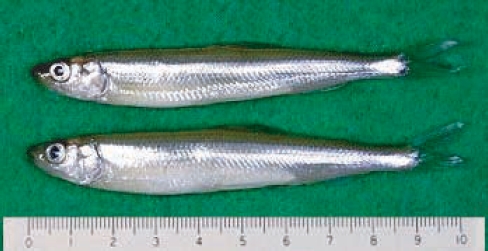
Fig. 1Pond smelts, Hypomesus olidus, collected from Uirimji (Lake), Chungchongbuk-do.
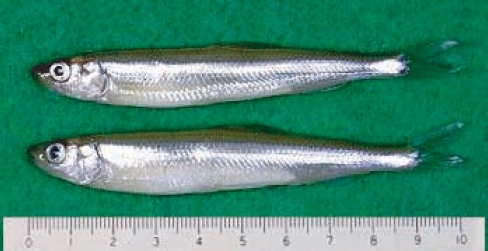
Fig. 2Collection areas of pond smelts, H. olidus, and other freshwater fishes.
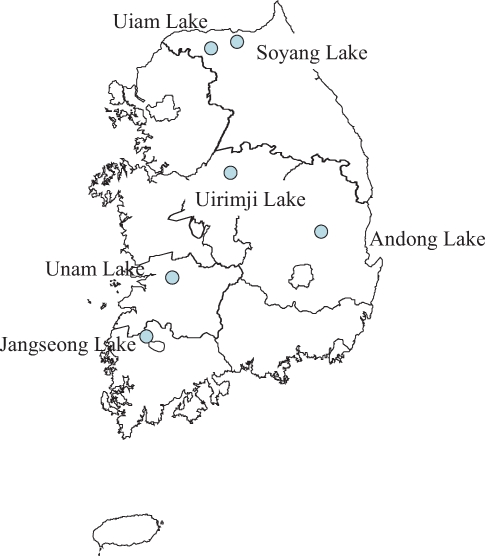
Table 1.Name and locations of lakes from which pond smelts, Hypomesus olidus, were collected
Table 1.
|
Name and location of lake |
Date examined (d/m/y)a)
|
No. of fish examined |
Length of fish (cm) |
Weight of fish (g) |
|
Soyang Lake, Gangwon-do |
21-01-2003 |
420 |
5.2~3.9 |
1.3~1.0 |
|
26-02-2003 |
717 |
5.4~4.2 |
1.3~1.1 |
|
09-12-2003 |
223 |
6.6~3.8 |
1.4~0.9 |
|
08-01-2004 |
520 |
6.4~4.3 |
1.4~1.0 |
|
19-01-2004 |
1,040 |
6.2~4.5 |
1.3~1.0 |
|
10-01-2005 |
1,000 |
3.5~5.9 |
1.2~0.9 |
|
Uiam Lake, Gangwon-do |
22-02-2005 |
56 |
4.5~8.8 |
1.9~1.2 |
|
Unam, Jeollabuk-do |
20-02-2004 |
300 |
5.2~8.0 |
1.8~1.3 |
|
Jangseong Lake, Jeollanam-do |
20-03-2004 |
200 |
7.5~10.2 |
1.9~1.5 |
|
Andong Lake, Gyeongsangbuk-do |
28-02-2004 |
200 |
5.3~6.9 |
1.5~1.1 |
|
Uirimji Lake, Chungchongbuk-do |
20-02-2004 |
185 |
5.5~9.3 |
1.9~6.0 |
|
Total |
|
4,861 |
6.9~4.7 |
1.5~1.1 |
Table 2.Infection status of lake fishes with trematode metacercariae
Table 2.
|
Name of lake |
Species of fish |
No. of fish infected/examined |
Fluke species |
No. of MCa) detected (Total No.) |
|
Soyang Lake |
H. olidus
|
0/3,920 |
NDb)
|
0 |
|
Uiam Lake |
H. olidus
|
0/56 |
ND |
0 |
|
Unam Lake |
Squalidus japonicus coreanus
|
1/1 |
Clonorchis sinensis
|
19 (19) |
|
H. olidus
|
0/300 |
ND |
0 |
|
Jangseong Lake |
H. olidus
|
4/200 |
Diplostomum sp. |
2-4 (12) |
|
Hemiculter eigenmanni
|
4/10 |
Diplostomum sp. |
1-2 (5) |
|
Opsariichthys uncirostris amurensis
|
2/2 |
Metorchis orientalis
|
10-12 (22) |
|
1/2 |
Metagonimus sp. |
6 (6) |
|
Zacco platypus
|
5/5 |
Metorchis orientalis
|
2-7 (18) |
|
|
2/5 |
Metagonimus sp. |
3-4 (7) |
|
Andong Lake |
H. olidus
|
0/200 |
ND |
0 |
|
Uirimji Lake |
H. olidus
|
0/185 |
ND |
0 |
Citations
Citations to this article as recorded by

- Infection characteristics of Diplostomum species (Digenea: Diplostomidae) metacercariae in fishes from Korea
Woon-Mok Sohn, Byoung-Kuk Na, Jung-A Kim, Hee-Ju Kim
Parasites, Hosts and Diseases.2026; 64(3): 195. CrossRef - Ultrasound-Assisted Enhancement of Gel Properties in Hypomesus olidus Surimi
Yuan Fu, Guochuan Jiang, Xing Sun, Shuibing Yang, Jiahang Yu, Xuejun Liu, Liyan Wang, Shuangjie Zhu
Foods.2025; 14(13): 2363. CrossRef - Physicochemical and functional properties of the muscle protein fraction of Hypomesus olidus
Yuan Fu, Chuanhao Liu, Xiaohui Yan, Guochuan Jiang, Qiao Dang, Liyan Wang, Xuejun Liu
Food Chemistry: X.2022; 16: 100484. CrossRef - Extraction, purification, characterization, anticoagulant activity, and anticoagulant mechanism of polysaccharides from the heads of Hypomesus olidus
Xuan Zhang, Xin‐Tong Ma, Yu Xu, Guo‐Chuan Jiang, Jia‐Lin Zhang, Xue‐Jun Liu, Xiao‐Hui Yan
Food Science & Nutrition.2020; 8(2): 849. CrossRef - Intestinal Flukes Recovered from a Herring Gull, Larus argentatus, in the Republic of Korea
Young-Il Lee, Min Seo, Jong-Yil Chai
The Korean Journal of Parasitology.2020; 58(1): 81. CrossRef - Monitoring of Lake area Change and Drought using Landsat Images and the Artificial Neural Network Method in Lake Soyang, Chuncheon, Korea
Jinah Eom, Sungjae Park, Bokyun Ko, Chang-Wook Lee
Journal of the Korean earth science society.2020; 41(2): 129. CrossRef - Prevalence of Clonorchis sinensis infection in freshwater fishes in northeastern China
Y. Zhang, Q.C. Chang, Y. Zhang, L. Na, W.T. Wang, W.W. Xu, D.Z. Gao, Z.X. Liu, C.R. Wang, X.Q. Zhu
Veterinary Parasitology.2014; 204(3-4): 209. CrossRef - Prevalence ofClonorchis sinensisMetacercariae in Freshwater Fish from Three Latitudinal Regions of the Korean Peninsula
Shin-Hyeong Cho, Woon-Mok Sohn, Byoung-Kuk Na, Tong-Soo Kim, Yoon Kong, Keeseon Eom, Won-Seok Seok, Taejoon Lee
The Korean Journal of Parasitology.2011; 49(4): 385. CrossRef - Infection Status of Freshwater Fish with Metacercariae of Clonorchis sinensis in Korea
Eun-Min Kim, Jae-Lip Kim, Sung Yil Choi, Jae-Whan Kim, Siwon Kim, Min-Ho Choi, Young Mee Bae, Soon-Hyung Lee, Sung-Tae Hong
The Korean Journal of Parasitology.2008; 46(4): 247. CrossRef - Survey for zoonotic liver and intestinal trematode metacercariae in cultured and wild fish in An Giang Province, Vietnam
Nguyen Diem Thu, Anders Dalsgaard, Ly Thi Thanh Loan, K. Darwin Murrell
The Korean Journal of Parasitology.2007; 45(1): 45. CrossRef