Abstract
In the past decade, experts have conducted parasitological research on archaeological specimens in Korea to collect historical parasite infection data. In these studies, parasitologists successfully described the infection pattern of each parasite species in history. However, in the first half of the 20th century, archaeoparasitological reports have been scant. In 2021, we conducted a parasitological examination of a toilet-like structure that emerged in the early 20th century. This structure was built by stacking 2 wooden barrels; and in the study samples, we found ancient Trichuris trichiura, Ascaris lumbricoides (unfertilized), and Taenia spp. eggs and therefore proposed a higher possibility that the barrels could have been used as a toilet at the time. To understand how the antihelminthic campaign since the 1960s helped reduce parasite infection rates in Korea, more research should focus on early-20th-century toilet ruins.
-
Key words: Ascaris, Trichuris, Taenia, toilet, Korea, Japanese colonial period
Archaeoparasitology aims to obtain scientific information that helps estimate parasite infections in history through parasitic examinations on samples from excavation sites [
1]. In Korea, researchers have also conducted parasitological studies on archaeological specimens over the past decade, enabling them to acquire important data concerning historical parasite infections [
2]. Archaeoparasitological studies in Korea have used coprolite samples from mummies or soil sediments from excavation sites. Studies from the Three Kingdoms to the Joseon Dynasty period have successfully revealed that parasitism has existed for a long time in Korea [
2–
4]. Particularly for the Joseon Dynasty period, the infection rate for each parasite species could also be estimated [
5,
6]. Considering the few opportunities to learn about the actual status of parasite infections before the 20th century, parasitological studies using ancient specimens could benefit parasitology and archaeology researchers.
Since the late 20th century, Korea has shown a remarkable decline in parasite infection rates because of rapid economic growth and the government’s and parasitologists’ antihelminthic campaigns [
2,
7]. With regard to historical parasite infection before this change, detailed information could be obtained through research on mummy coprolites from the graves at that time [
2]. Nevertheless, for the first half of the 20th century, reports on mummies of the time at archaeological sites have been extremely rare. Although toilet ruins are therefore bound to be the only useful specimen for studies on parasite infection of the time, parasitological reports on archaeological samples have so far been scant.
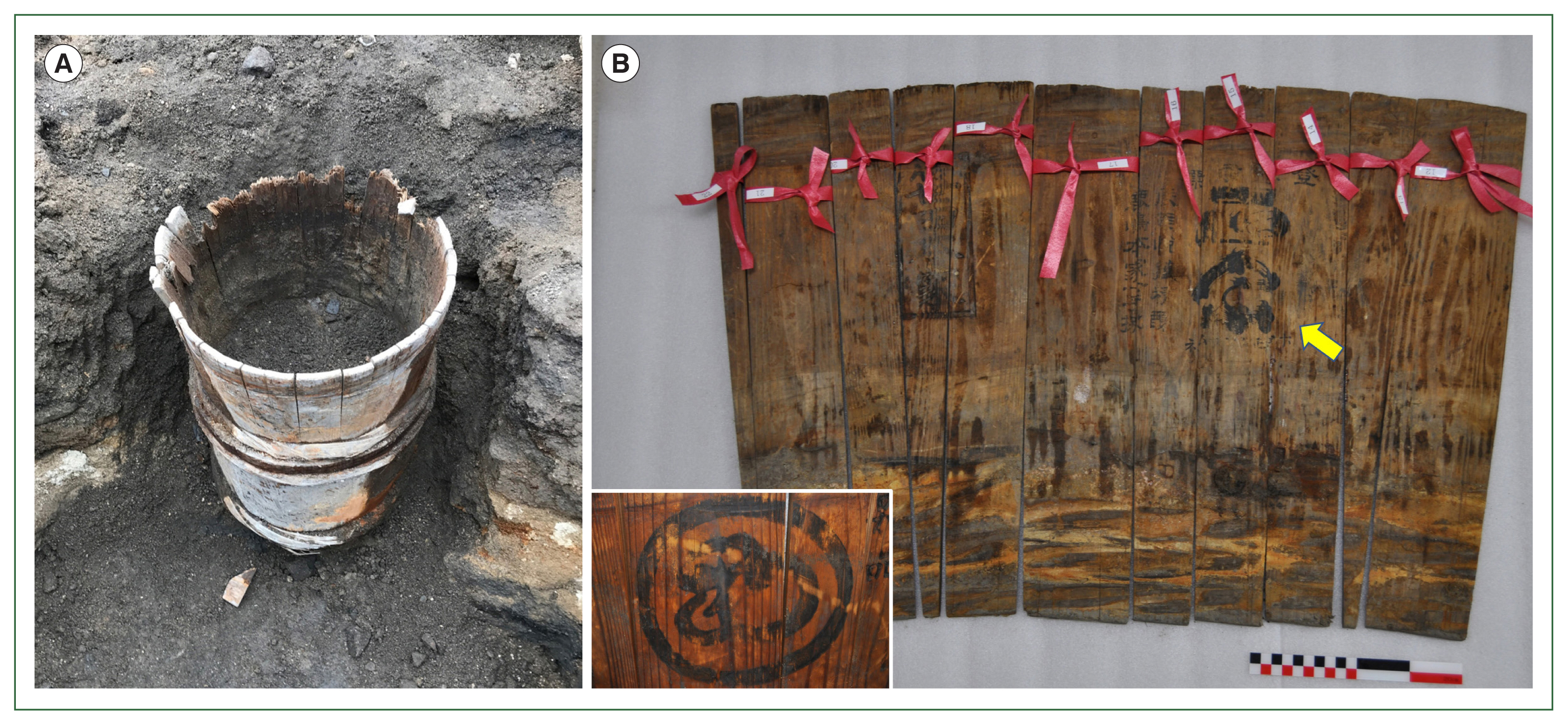
In 2021, an archaeological investigation was conducted at the Sewoon Reorganization Promotion Zone in Ipjeong-dong, Seoul City. During the Joseon Dynasty period, this area was located southeast of Old Seoul City. During the excavation, archaeologists identified various remains including 20 buildings and concrete red-brick structures. The buildings and structures were estimated to be of the late 19th to the early 20th century, from which fragments of Japanese porcelain, glass bottles, and coins were collected. Specifically, a wooden structure that resembles a toilet could be identified in Building No. 7, which is likely an underground structure of the toilet in terms of form. This toilet-like structure was built by stacking 2 wooden barrels, and the inside of it was full of soil sediments (
Fig. 1A).
Investigating the barrels has allowed for the date estimation of the toilet. In our opinion, one barrel was first used as a container for early 20th-century Japanese liquor because the name of a liquor manufacturer, “Masamune,” could be identified on the barrel. Next, the name of a vinegar company, “Sasadahonke,” was also found on the barrel, so the vinegar company seemed to have recycled what was originally a liquor container as their vinegar container (
Fig. 1B). If this is actually a toilet ruin, it could be the first report on a toilet during the early 20th-century colonial period. However, archaeologists could not confirm this estimation onsite. They commissioned us to examine the samples by parasitological method.
We decided to collect samples from different levels (layers I–VII) of wooden barrels while removing soil from top to bottom. Each soil specimen (1.33–4.64 g) was rehydrated in 0.5% trisodium phosphate solution and then filtered with multiple-layered gauze. The obtained precipitate was dissolved in 0.5% trisodium phosphate solution again (with a final volume of 20 ml). The specimen slides were examined using a light microscope (BH-2; Olympus, Tokyo, Japan) [
8–
10].
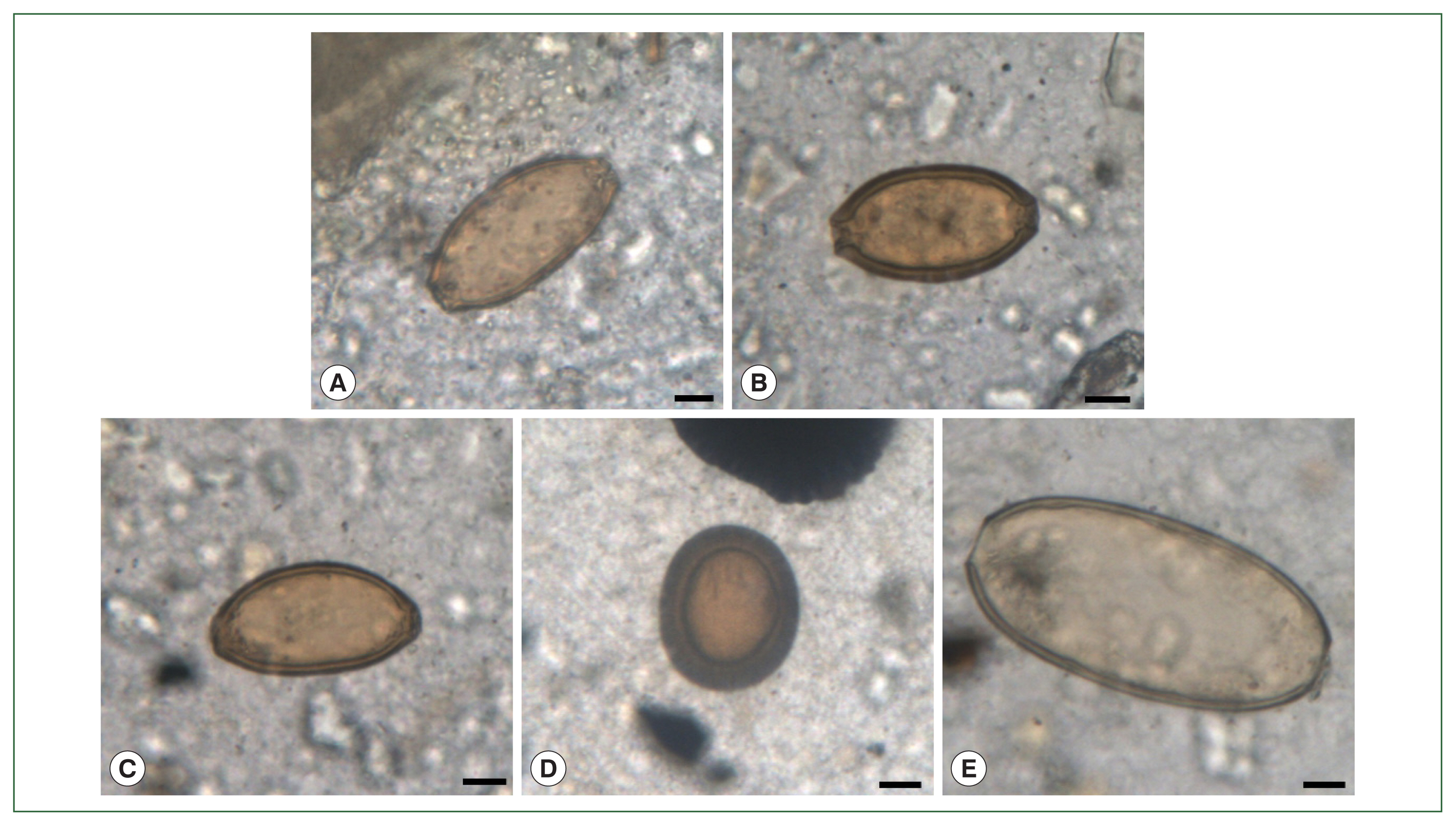
Among the 7 sample layers, we found ancient parasite eggs of
Trichuris trichiura, Ascaris lumbricoides (unfertilized), and
Taenia spp. in specimens from layers V, VI, and VII (
Fig. 2), suggesting that the barrels could have been used as toilets at the time. Particularly, parasite eggs were found only in the lower 3 layers (V–VII), indicating that feces were deposited at the bottom of the barrel when the structure was used as a toilet. The soil on the upper layers (I–IV) might not be deposits of toilet feces but rather the topsoil that has been pushed inward when this barrel toilet was finally abandoned.
Table 1 provides a summary of the parasitological examination’s eggs per gram (EPG) and related information. Our parasitological analysis suggests that the liquor-vinegar barrel appears to have been recycled as a toilet. Since the use of wooden barrels for toilets was a common tradition practiced in Edo-period Japan [
11], the Japanese people who used this barrel toilet are likely those who lived in the area between 1910 and 1945.
Although the early 20th century might be deemed too recent of an era to be the subject of archaeoparasitological research, it is an important period to understand how parasite infections have historically changed in East Asia, considering that it was just before the late 20th century, when parasite infection rates sharply dropped. We note that a parasitic examination of early 20th-century specimens has also been reported in Taiwan. Yeh et al. [
12] published a report on samples from a Japanese police outpost stationed in Taiwan from 1921 to 1944. In these specimens, they confirmed the presence of ancient parasite eggs of
Eurytrema sp.,
T. trichiura, and
A. lumbricoides. Taken together, despite years of archaeoparasitological research, some academic queries about parasitism in East Asian history have yet to be fully answered. More research should focus on early 20th-century ruins to understand the achievements of the anthelminthic campaign after the 1960s on the reduction in parasite infection rates in East Asian countries.
Notes
-
The authors declare no conflicts of interest related to this study.
-
Author contributions
Conceptualization: Seo M, Chai JY, Shin DH
Data curation: Kim J, Seo M, Fujita H, Park JW, Jang JW, Jang IS, Shin DH
Formal analysis: Kim J, Shin DH
Funding acquisition: Shin DH
Investigation: Kim J, Fujita H, Park JW, Jang JW, Jang IS, Shin DH
Methodology: Kim J, Seo M, Shin DH
Project administration: Seo M, Shin DH
Supervision: Shin DH
Validation: Chai JY, Shin DH
Visualization: Shin DH
Writing – original draft: Kim J, Seo M, Fujita H, Shin DH
Writing – review & editing: Seo M, Shin DH
Acknowledgment
This research was supported by the Education and Research Encouragement Fund of Seoul National University Hospital (2023).
Fig. 1A wooden structure found at the Building No. 7 ruins. (A) The toilet-like structure was made by stacking 2 wooden barrels. (B) Date estimation of the barrels. Note the marking of an early 20th-century Japanese liquor (yellow arrow) and the trademark of a Japanese vinegar company (inset of B).

Fig. 2Ancient parasite eggs found in specimens from layers V, VI, and VII. (A–C) Trichuris trichiura. (D) Taenia sp. (E) Ascaris lumbricoides (unfertilized). Bars=10 mm.

Table 1Archaeological and parasitological information of the specimens in the current report
Table 1
|
Site |
Sampling at |
Results |
Eggs per gram |
|
Sewoon reorganization promotion zone located in Ipjeong-dong, Seoul City |
Upper layers of barrel-toilet (layers (I to IV) |
Negative |
ND |
|
|
Lower layers of barrel-toilet (layers V to VII) |
Trichuris trichiura
|
12.8 |
|
Taenia spp. |
4.8 |
|
Ascaris lumbricoides (unfertilized) |
4.8 |
References
- 1. Reinhard K, Slepchenko S, Shin DH. Archaeoparasitology. In: Smith C, editor. Encyclopedia of Global Archaeology. Springer; Cham. New York, USA. 2018. p. 1-9.
- 2. Seo M, Hong JH, Reinhard KJ, Shin DH. Archaeoparasitology of Korean mummies. In: Shin DH, Bianucci R, editors. The Handbook of Mummy Studies. Springer; Singapore. Singapore. 2021. p. 439-459.
- 3. Seo M, Araujo A, Reinhard K, Chai JY, Shin DH. Paleoparasitological studies on mummies of the Joseon Dynasty, Korea. Korean J Parasitol 2014;52(3):235-242. https://doi.org/10.3347/kjp.2014.52.3.235
- 4. Seo M, Chai JY, Kim MJ, Shim SY, Ki HC, et al. Detection Trend of Helminth Eggs in the Strata Soil Samples from Ancient Historic Places of Korea. Korean J Parasitol 2016;54(5):555-563. https://doi.org/10.3347/kjp.2016.54.5.555
- 5. Seo M, Oh CS, Hong JH, Chai JY, Cha SC, et al. Estimation of parasite infection prevalence of Joseon people by paleoparasitological data updates from the ancient feces of pre-modern Korean mummies. Anthropol Sci 2017;125(1):9-14. https://doi.org/10.1537/ase.160920
- 6. Oh CS, Chai JY, Min SR, Oh KT, Seol J, et al. Updates of Joseon period parasite infection prevalence by parasitological studies on human coprolites from archaeological sites of Euijeongbu, Gumi and Wonju cities. Parasites, Hosts and Diseases 2023;61(1):89-93. https://doi.org/10.3347/PHD.22129
- 7. Lee SH. Transition of Parasitic Diseases in Korea. J Korean Med Assoc 2007;50(11):937-945. https://doi.org/10.5124/jkma.2007.50.11.937
- 8. Callen EO, Cameron TWM. A prehistoric diet as revealed in coprolites. New Sci 1960;8:35-40.
- 9. Criscione CD, Anderson JD, Sudimack D, Peng W, Jha B, et al. Disentangling hybridization and host colonization in parasitic roundworms of humans and pigs. Proc Biol Sci 2007;274(1626):2669-2677. https://doi.org/10.1098/rspb.2007.0877
- 10. Shin DH, Oh CS, Lee SJ, Chai JY, Kim J, et al. Paleo-parasitological study on the soils collected from archaeological sites in old district of Seoul City. J Arch Sci 2011;38(12):3555-3559. https://doi.org/10.1016/j.jas.2011.08.024
- 11. Folk Museum of Ota-City. Toilet archaeology. Tokyo Bizyutsu; Tokyo, Japan. 1997. p. 89-91.
- 12. Yeh HY, Cheng CJ, Huang C, Zhan X, Wong WK, et al. Discovery of Eurytrema eggs in sediment from a colonial period latrine in Taiwan. Korean J Parasitol 2019;57(6):595-599. https://doi.org/10.3347/kjp.2019.57.6.595
Citations
Citations to this article as recorded by

- Paleoparasitology of historical toilets and mummies in South Korea: trends and perspectives
Jong Ha Hong, Yangsu Yi, Min Seo, Seung Hee Baek, Jinseong Han, Hisashi Fujita, Chang Seok Oh, Dong hoon Shin
Parasitology.2026; : 1. CrossRef - Problems in Japanese archaeoparasitology: Analysis of paleo-parasitic eggs from Hachinohe Castle
Hisashi Fujita, Masako Funaba, Shiori O. Fujisawa
Parasites, Hosts and Diseases.2025; 63(3): 278. CrossRef


 , Min Seo2,*