Abstract
The present study investigated the infection status of digenetic trematode metacercariae (DTM) in freshwater fish from Banbyeon-cheon in Yeongyang-gun, Gyeongsangbuk-do, Korea. A total of 211 freshwater fish representing 11 species were examined using the artificial digestion method in October 2023. Six taxa of DTM, including Clonorchis sinensis, Metagonimus spp., Centrocestus armatus, echinostomes, Exorchis oviformis, and Metacercaria hasegawai, were detected. The overall prevalence of DTM was 92.4% among the fish examined. The prevalence of C. armatus was the highest (52.8%), followed by E. oviformis (51.6%), M. hasegawai (35.6%), echinostomes (31.0%), C. sinensis (16.1%), and Metagonimus spp. (6.9%) in positive fish species. The infection intensity of C. armatus was 126 metacercariae per infected fish, whereas those of C. sinensis and Metagonimus spp. were 20 and 5.8 per infected fish, respectively. These findings indicate that at least 6 taxa of DTM, including C. sinensis and Metagonimus spp., are prevalent to varying degrees in fish from Banbyeon-cheon in Yeongyang-gun, Gyeongsangbuk-do, Korea. However, the potential risk of fishborne zoonotic trematodes, particularly C. sinensis, appears to be markedly lower than that reported in previous studies.
-
Key words: Banbyeon-cheon, digenetic trematode metacercariae, Clonorchis sinensis, freshwater fish, Yeongyang-gun
Infections caused by fishborne zoonotic trematodes are widely recognized as important public health problems in Korea. Among these, clonorchiasis caused by
Clonorchis sinensis remains one of the most significant parasitic diseases, particularly in riparian areas, as reported by the Korea Disease Control and Prevention Agency [
1]. Although the endemicity of these infections has reportedly decreased over time, they continue to pose a substantial public health concern [
2].
Beyond their zoonotic significance, digenetic trematode metacercariae (DTM) are also useful for characterizing trematode transmission in freshwater ecosystems. Infections are caused by trematodes whose infective larval stage, the metacercaria, commonly utilizes fish as an intermediate host and serves as a source of infection for definitive hosts, including humans [
3]. In addition, DTM species in fish intermediate hosts serve as important bioindicators of ecosystem health and reflect the infection status of adult trematodes in definitive hosts.
In Korea, numerous surveys have investigated the infection status of DTM in freshwater fish across diverse ecological habitats to evaluate their endemicity, particularly within various regions of Nakdong-gang (“gang” means river). These studies, spanning both the upper and lower reaches of the river, have documented the prevalence and distribution of DTM infections [
4-
9].
Banbyeon-cheon (“cheon” means stream) in Yeongyang-gun (“gun” means county) is located among agricultural fields, villages, and townships and forms part of the tributary network of the Nakdong-gang basin, where previous studies have reported persistent endemicity of DTM infections [
5]. Adjacent tributaries, including Wi-cheon in Gunwi-gun, Yongjeon-cheon in Cheongsong-gun, and Gilan-cheon in Andong-si (“si” means city), Gyeongsangbuk-do (“do” means province), have been identified as endemic hotspots for zoonotic DTM species, particularly
C. sinensis [
10-
12]. However, investigations specifically examining DTM prevalence in Banbyeon-cheon remain limited. To date, studies of DTM infections, including
C. sinensis,
Centrocestus armatus, and
Metagonimus spp., in fish from this area have only been included as part of broader regional investigations [
13-
15]. Comprehensive analyses of other DTM species and overall parasite assemblages in this river have not yet been conducted. Therefore, the present study aimed to investigate the infection status of DTM species in freshwater fish from Banbyeon-cheon in Yeongyang-gun, Gyeongsangbuk-do.
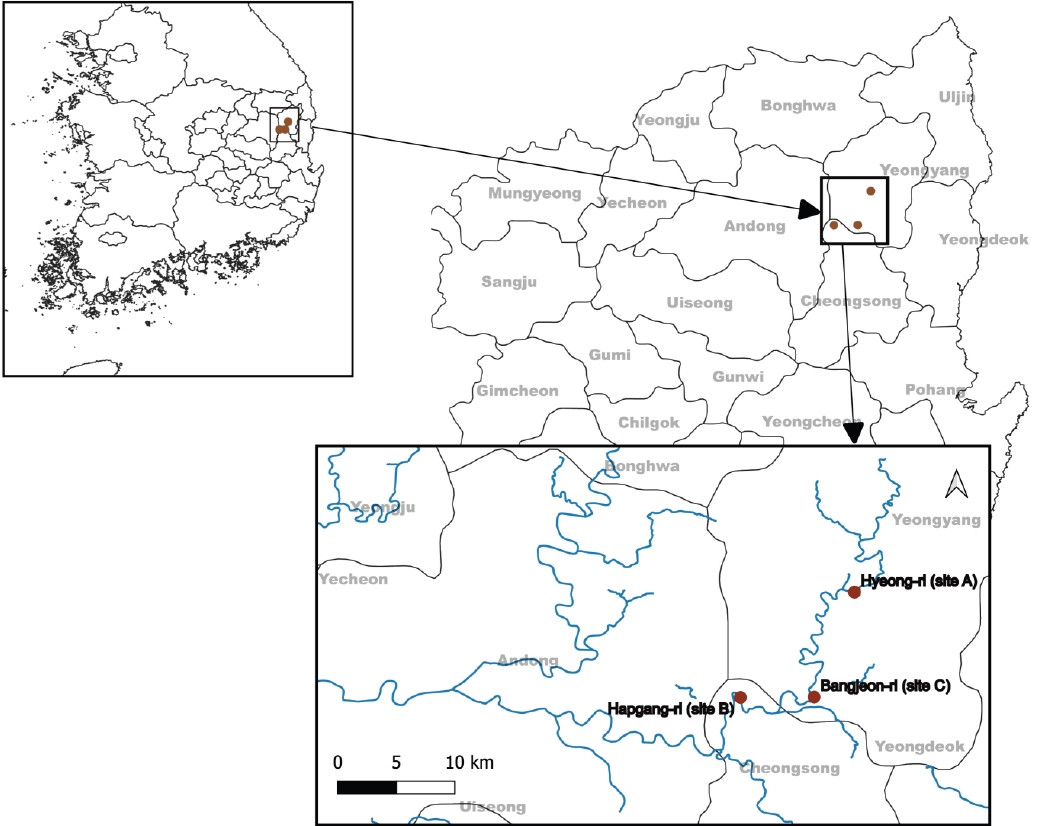
Fish collection was conducted at 3 sites along Banbyeon-cheon in Yeongyang-gun, Gyeongsangbuk-do (site A: Hyeong-ri in Yeongyang-eup, latitude 36.6477°, longitude 129.1177°; site B: Hapgang-ri in Ibam-myeon, latitude 36.5870°, longitude 129.0744°; and site C: Bangjeon in Ibam-myeon, latitude 36.5535°, longitude 129.0900°) (
Fig. 1). All lakes and rivers in the map figure were represented using consistent line widths.
A total of 211 freshwater fish representing 11 species were collected, including 139 individuals from site A, 67 individuals from site B (9 species), and 5 individuals from site C (4 species). Fish were collected using gill nets, casting nets, and stake nets at all surveyed sites in October 2023 with permission from the local government authorities. Because all 3 collection sites were located within close proximity and exhibited no ecologically significant differences, they were considered part of a single water system. The collected fish were transported on ice to the laboratory of the Department of Parasitology, School of Medicine, Chungbuk National University, Cheongju, Korea. Fish species were identified according to a published atlas [
16], and each specimen was individually weighed and measured for length (
Supplementary Tables S1-
S7). Subsequently, each fish was homogenized using a mortar and pestle. The homogenized tissue was transferred to a beaker, mixed with 1% acid pepsin solution, and incubated for 2 h at 36°C for digestion. After incubation, the digested material was filtered through a 1×1 mm² mesh and rinsed with 0.85% saline until the supernatant became clear. The sediment was then carefully examined under a stereomicroscope. All DTM specimens were individually collected and identified according to their general morphological characteristics [
17]. Thereafter, the prevalence (%) and mean intensity of infection (number of DTM per infected fish) were calculated.
Six taxa of DTM, including
C. sinensis,
Metagonimus spp.,
C. armatus, echinostomes,
Exorchis oviformis, and M. hasegawai, were detected. The overall prevalence of DTM was 92.4% among all fish examined (
Table 1). For each trematode taxon, prevalence was calculated as the proportion of infected fish relative to the total number of examined individuals within host species in which the parasite was detected.
Among the detected parasite taxa,
C. armatus metacercariae exhibited the highest prevalence (52.8%), with 94 infected individuals among 178 fish from 9 positive fish species (PFS), and an average density of 126 per infected fish (PFI).
E. oviformis was the second most prevalent species 51.6%, recorded in 108 infected fish among 209 individuals from 9 PFS, with an average density of 88.8. M. hasegawai (35.6%; 62 infected individuals among 174 fish from 8 PFS; average density, 40.3). This was followed closely by echinostomes having a prevalence of 31.0%; 26 infected individuals among 84 fish from 5 PFS with an average density of 17.
C. sinensis (16.1%; 26 infected individuals among 167 fish from 7 PFS; average density, 20) and
Metagonimus spp. (6.9%; 13 infected individuals among 186 fish from 6 PFS; average density, 5.8). The overall prevalence and infection intensities of DTM according to fish species are summarized in
Table 1 and
Supplementary Tables S8-
S13.
In the present investigation, 6 taxa of DTM were detected in 11 fish species collected from Banbyeon-cheon in Yeongyang-gun, Gyeongsangbuk-do, Korea. The prevalence of individual parasite taxa varied markedly, with some species showing comparatively high infection rates, whereas others exhibited relatively low prevalence compared with findings from adjacent environments.
Consistent with the results of previous studies, our findings suggest that the overall infection levels, particularly those of
C. sinensis, may have declined compared with previous reports from nearby tributaries within the Nakdong-gang system. Adjacent streams, including Wi-cheon and Yongjeon-cheon, have been reported to show prevalence rates of 59.9% with an infection intensity of 677.1 PFI (2011 and 2013–2017) and 65.5% with an intensity of 453.0 PFI (2019–2020), respectively [
10,
11]. Similarly, Lee et al. [
12] reported that the prevalence of
C. sinensis metacercariae (CsMc) in fish from Yongjeon-cheon was 50% (125 PFI), whereas that in fish from Gilan-cheon was 49% (79 PFI), indicating sustained high transmission in neighbouring streams. Furthermore, Sohn et al. [
13] reported a prevalence of 81.6% and an infection intensity of 190.1 PFI in Banbyeon-cheon between 2010 and 2020. Although their investigation was conducted at a single site, the present study included 3 sampling sites and observed a substantially lower prevalence. The reason for this marked difference remains uncertain but may reflect spatial and temporal differences in sampling and DTM transmission dynamics. Overall, the present findings indicate a lower prevalence of CsMc than that reported in earlier investigations conducted in the upper reaches of Nakdong-gang.
Consequently, the susceptibility index (SI; prevalence/100 × average intensity of DTM PFI) [
18] in the present study was 3.2, which was substantially lower than the values reported previously for Banbyeon-cheon (SI, 155.1), Yongjeon-cheon (SI, 402.9 and 40.3), Gilan-cheon (SI, 62.3), and Wi-cheon (SI, 297.2). In the present study,
Pungtungia herzi, a recognized index species for CsMc in Korea, showed an SI of only 4.5, which was markedly lower than values reported previously from other streams, some of which exceeded 1,000 [
10-
12]. For example, Sohn et al. [
11] reported an SI of 1,060.7 for
P. herzi from Yongjeon-cheon. These findings suggest a potential reduction in clonorchiasis risk in this environment, although continuous surveillance is required to confirm this trend. This decline may be associated with changes in fish community composition, including reductions in highly susceptible species such as
P. herzi, as well as broader national control programs aimed at interrupting the parasite life cycle through fecal management and related interventions implemented by the Korea Disease Control and Prevention Agency.
Among the other DTM species,
Centrocestus armatus metacercariae (CaMc) showed the highest prevalence (52.8%) in PFS, whereas
Metagonimus spp. showed the lowest prevalence (6.9%). The remaining taxa, including echinostomes (31.0%),
E. oviformis (51.6%), and M. hasegawai (35.6%), exhibited intermediate prevalence levels. The high prevalence of CaMc in
Zacco platypus (94.1%) is consistent with previous reports from Nakdong-gang, where CaMc was reported to be nearly ubiquitous in Zacco species [
14]. Persistent high infection rates in chub fish suggest that this parasite remains widespread and may serve as a reliable indicator of DTM burden in the region. In contrast, the very low prevalence of
Metagonimus spp. may reflect the limited distribution of highly susceptible host species, particularly
Plecoglossus altivelis. This low endemicity is consistent with findings from other Nakdong-gang studies, excluding Deokcheon-gang, where prevalence reached 87.5% [
15,
18]. These results suggest that host fish distribution may influence local parasite transmission.
These results support continued monitoring of DTM infections in fish from the Nakdong-gang water system. In the present study, 6 taxa of DTM, including C. sinensis and Metagonimus spp., were detected in fish from Banbyeon-cheon in Yeongyang-gun. However, compared with earlier reports from Banbyeon-cheon and adjacent streams in the upper reaches of Nakdong-gang, the potential risk of fishborne zoonotic trematodes, particularly C. sinensis, appears to have decreased substantially.
Notes
-
Author contributions
Conceptualization: Opara E, Choe S. Data curation: Opara E, Lee HE, Lee MR, Choe S. Formal analysis: Opara E, Kim S, Choe S. Funding acquisition: Choe S. Investigation: Opara E, Lee HE, Lee HW. Methodology: Lee HW, Opara E. Project administration: Bia MM, Choe S. Supervision: Choe S. Writing – original draft: Opara E, Choe S. Writing – review & editing: Kim S, Choe S.
-
Conflict of interest
The authors have no conflicts of interest to declare.
-
Funding
This work was supported by the Brain Korea Scholarship 21 and Korea Disease Control and Prevention Agency (grant No. 6331-311-260-01, 2023).
Supplementary information
Fig. 1.Map of the surveyed sites in the water systems of Banbyeon-cheon in Yeongyang-gun, Gyeongsangbuk-do, Korea.
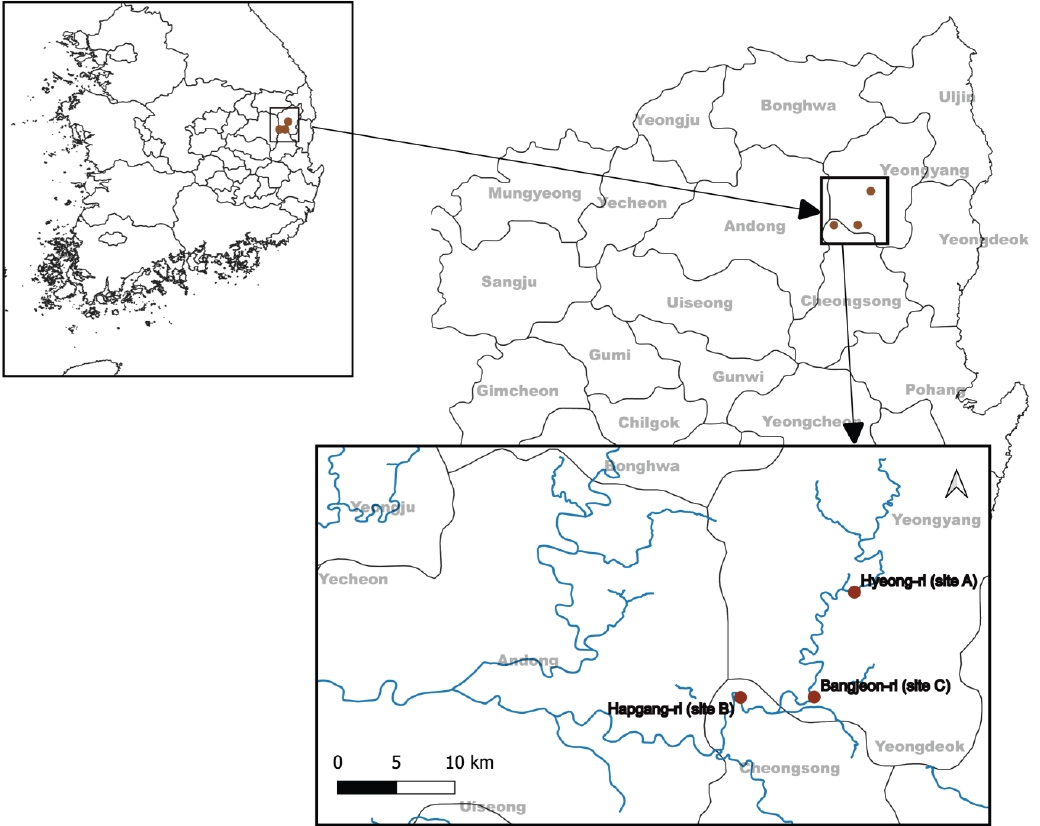
Table 1.Infection status of digenetic trematode metacercariae in freshwater fish from Banbyeon-cheon in Yeongyang-gun, Gyeongsangbuk-do, Korea
Table 1.
|
Fish species examined |
Fish examined |
Clonorchis sinensis
|
Metagonimus spp. |
Centrocestus armatus
|
Echinostomes |
Exorchis oviformis
|
Metacercaria hasegawai |
|
Fish infected |
Average |
Fish infected |
Average |
Fish infected |
Average |
Fish infected |
Average |
Fish infected |
Average |
Fish infected |
Average |
|
Acheilognathus lanceolatus
|
32 |
1 (3.1) |
8 |
5 (15.6) |
2 |
- |
- |
- |
- |
25 (78.1) |
9 |
13 (40.6) |
126.7 |
|
Acheilognathus majusculus
|
12 |
2 (16.7) |
5.5 |
1 (8.3) |
1 |
1 (8.3) |
1 |
4 (33.3) |
2.5 |
12 (100) |
11 |
12 (100) |
6 |
|
Carassius auratus
|
1 |
- |
- |
- |
- |
- |
- |
- |
- |
- |
- |
- |
- |
|
Coreoperca herzi
|
7 |
- |
- |
- |
- |
2 (28.5) |
1,068 |
- |
- |
3 (42.8) |
3 |
1 (14.2) |
1 |
|
Misgurnus anguillicaudatus
|
1 |
- |
- |
- |
- |
1 (100) |
2 |
- |
- |
- |
- |
- |
- |
|
Nipponocypris temminckii
|
35 |
- |
- |
2 (5.7) |
9 |
33 (92.4) |
139 |
- |
- |
2 (6.1) |
5 |
- |
- |
|
Pungtungia herzi
|
51 |
14 (27.4) |
16.6 |
3 (6) |
3.3 |
2 |
12 |
16 (31.3) |
34 |
45 (88.2) |
139 |
18 (35.3) |
6.4 |
|
Pseudogobio esocinus
|
5 |
1 (20) |
6 |
1 (20) |
26 |
1 (20) |
1 |
3 (60) |
3.5 |
5 (100) |
19 |
2 (40) |
3.5 |
|
Sarcocheilichthys nigripinnis morii
|
8 |
5 (62.5) |
8 |
- |
- |
1 (37.5) |
2 |
1 (12.5) |
1 |
5 (33.3) |
39 |
6 (75) |
4 |
|
Squalidus japonicus koreanus
|
8 |
2 (25) |
13 |
- |
- |
4 (50) |
3.8 |
2 (25) |
4 |
3 (100) |
44 |
7 (85.7) |
4.7 |
|
Zacco platypus
|
51 |
2 (3.9) |
1 |
1 (1.9) |
1 |
48 (94.1) |
144 |
- |
- |
3 (17.3) |
5.3 |
3 (5.8) |
1 |
|
Total |
211 |
27 (16.1) |
20 |
13 (6.9) |
5.8 |
94 (52.8) |
126 |
26 (31) |
17 |
108 (51.6) |
88.8 |
62 (35.6) |
40.3 |
References
- 1. Korea Centers for Disease Control and Prevention; Korea National Institute of Health. National survey of the prevalence of intestinal parasitic infections in Korea, 2012: the 8th report. Korea Centers for Disease Control and Prevention; 2013.
- 2. Lee MR, Shin HE, Back SO, et al. Status of helminthic infections in residents around river basins in the Republic of Korea for 10 years (2011-2020). Korean J Parasitol 2022;60:187-93. https://doi.org/10.3347/kjp.2022.60.3.187
- 3. Gibson DI. Subclass digenea Carus. Gibson DI, Jones A, Bray RA. Keys to the Trematoda. Vol. 1. CABI and Natural History Museum; 2001. p. 15-8.
- 4. Chun SK. Studies on some trematodes whose intermediate hosts are fish in the Naktong River. Bull Fish Coll Pusan Natl Univ 1962;4:21-38.
- 5. Lee JT. Studies on the metacercariae from freshwater fishes in the Kum-Ho River. Korean J Parasitol 1968;6:77-99. https://doi.org/10.3347/kjp.1968.6.3.77
- 6. Hwang JT, Choi DW. Changing pattern of infestation with larval trematodes from freshwater fish in river Kumho, Kyungpook Province, Korea. Kyungpook Univ Med J 1980;21:460-75.
- 7. Kong HH, Choi BR, Moon CH, Choi DW. Larval digenetic trematodes from fresh water fish in river Miryang, Korea. Jpn J Parasitol 1995;44:112-8.
- 8. Sohn WM, Choi YS. Infection status with trematode metacercariae in the fresh-water fish from Chunamchosuchi (pond), Uichang-gun, Kyongsangnam-do, Korea. Korean J Parasitol 1997;35:165-70. https://doi.org/10.3347/kjp.1997.35.3.165
- 9. Sohn WM, Na BK. Infections with digenetic trematode metacercariae in freshwater fishes from two visiting sites of migratory birds in Gyeongsangnam-do, Republic of Korea. Korean J Parasitol 2019;57:273-81. https://doi.org/10.3347/kjp.2019.57.3.273
- 10. Sohn WM, Na BK, Cho SH, Ju JW, Son DC. Prevalence and intensity of Clonorchis sinensis metacercariae in freshwater fish from Wicheon stream in Gunwi-gun, Gyeongsangbuk-do, Korea. Korean J Parasitol 2018;56:41-8. https://doi.org/10.3347/kjp.2018.56.1.41
- 11. Sohn WM, Na BK, Cho SH, et al. High endemicity with Clonorchis sinensis metacercariae in fish from Yongjeon-cheon (stream) in Cheongsong-gun, Gyeong-sangbuk-do, Korea. Korean J Parasitol 2021;59:97-101. https://doi.org/10.3347/kjp.2021.59.1.97
- 12. Lee MR, Ju JW, Baek SO, Lee YJ, Lee HI. The survey of infection status of Clonorchis sinensis metacercariae of freshwater fish in 2022. Jugan Geongang Gwa Jilbyeong 2023;16:1455-63. https://doi.org/10.56786/PHWR.2023.16.43.1
- 13. Sohn WM. Infection characteristics of Clonorchis sinensis metacercariae in fish from Republic of Korea. Korean J Parasitol 2022;60:79-96. https://doi.org/10.3347/kjp.2022.60.2.79
- 14. Sohn WM, Na BK, Cho SH, et al. Infections with Centrocestus armatus metacercariae in fishes from water systems of major rivers in Republic of Korea. Korean J Parasitol 2018;56:341-9. https://doi.org/10.3347/kjp.2018.56.4.341
- 15. Sohn WM. Infection characteristics of Metagonimus species (Digenea: Heterophyidae) metacercariae in fish from major rivers of Korea. Parasites Hosts Dis 2024;62:1-29. https://doi.org/10.3347/PHD.23096
- 16. Kim IS, Kang EJ. Coloured fishes of Korea. Academy Publishing Company; 1993.
- 17. Sohn WM. Fish-borne zoonotic trematode metacercariae in the Republic of Korea. Korean J Parasitol 2009;47 Suppl:S103-13. https://doi.org/10.3347/kjp.2009.47.S.S103
- 18. Sohn WM, Na BK, Cho SH, et al. Endemicity of zoonotic trematode metacercariae in fish from Deokcheon-gang (river) in Sancheong-gun, Gyeongsangnam-do, Republic of Korea. Korean J Parasitol 2021;59:523-9. https://doi.org/10.3347/kjp.2021.59.5.523


 , Ha-Eun Lee1