Abstract
The present study was performed to investigate the infection status of zoonotic intestinal helminths in field mice captured from 7 local sites of Jeollabuk-do, Korea. A total of 78 Apodemus agrarius were collected in 7 survey sites, i.e., Sunchang-gun, Wanju-gun, Imsil-gun, Muju-gun, Gochang-gun, Jeonju-si, and Namwon-si, with Sherman live traps (Bioquip) for the surveillance of rodent-borne diseases through 2 times in 2019. The small intestine of each mouse was resected and longitudinally opened using scissors. The intestinal contents were washed with 0.85% saline until the supernatant became clear. The helminthic worms were collected with naked eyes and/or under a stereomicroscope from the sediment of the intestinal content. A total of 3 species of zoonotic intestinal helminths (1 trematode sp. and 2 cestode spp.) were collected. Plagiorchis muris were found in the small intestines of 7 (9.0%) mice (from Sunchang, Muju, Jeonju, and Namwon). Two species of tapeworm, Hymenolepis nana (from all survey sites except Wanju) and Hymenolepis diminuta (from Wanju, Imsil, and Namwon) were detected in 14 (17.9%) and 4 (5.1%) mice, respectively. The ventral view of P. muris was morphologically described. In this study, it was confirmed that 3 species of zoonotic intestinal helminths, P. muris, H. nana, and H. diminuta, are prevalent in striped field mice from Jeollabuk-do, Korea.
-
Key words: Zoonotic intestinal helminth, Plagiorchis muris, Hymenolepis nana, Hymenolepis diminuta, Apodemus agrarius, Jeollabuk-do
Surveys on the rodent helminths of medical and veterinary importance have been performed to prevent disease transmission to human and domestic animals. A variety of rodent species were investigated in various regions of the world [
1]. The striped field mouse,
Apodemus agrarius, is the most dominant species and the agricultural pillager in Korea. This mouse species is widely and abundantly distributed in rural areas, especially forest in small mountains and agricultural fields, of Korea. It causes a great deal of economic loss in agricultural products and also acts as the natural transmitter for zoonotic parasites as well as pathogens like tularemia, leptospirosis, and hemorrhagic fever [
2].
Since Nakamura and Kobayashi [
3] first reported 2 species of helminths as the rodent parasites in Korea, many researchers have studied the helminthic infections of rodents. Ogura [
4] reported 2 species of tapeworms,
Hymenolepis diminuta and
Hymenolepis nana, and Park [
5] described
Isthmiophora hortensis (syn.
Echinostoma hortense) from the small intestine of brown rats,
Rattus norvegicus. Seo et al. [
6], Seo et al. [
7], and Seo et al. [
8] found and listed a variety of helminth species from the various species of rodent hosts in Korea. Seo et al. [
9] detected 6 trematode species from 170 house rats,
Rattus spp., collected from 13 localities of Korea. Lee et al. [
10] also detected 6 trematode species in 2 brown rats from Yangyang-gun, Gangwon-do. Yong et al. [
11] reported the infections of 2 protozoa and 7 helminth species from 107 field mice examined. Seong et al. [
12] found 3 helminth species in 43 brown rats from Chuncheon-si, Gangwon-do.
In the 2000s, Chai et al. [
13], Chai et al. [
14], and Chai et al. [
15] described infections with
Plagiorchis muris,
Neodiplostomum seoulense (syn.
Fibricola seoulensis), and echinostomes in field mice from northern Gyeonggi-do near the Demilitarized Zone in Korea. Lee et al. [
16] reported the infections of intestinal helminths in 43
A. agrarius and 11
Apodemus peninsulae caught from 3 sites of Yanggu-gun and Inje-gun in northern Gangwon-do. Sohn et al. [
17] described the infection status of intestinal helminths in striped field mice from 2 southern regions, Hapcheon-gun, Gyeongsangnam-do, and Gurye-gun, Jeollanam-do. Lee et al. [
18] surveyed the infection status of intestinal helminths in 2 species of field mice,
A. agrarius and
A. peninsulae, captured in the mountainous areas and agricultural fields of Gangwon-do and Chungcheongnam-do. Kim et al. [
19] reported a case of fascioliasis in a wild nutria,
Myocastor coypus, in Korea. Recently, we performed a survey to know the infection status of zoonotic intestinal helminths (ZIH) in striped field mice,
A. agrarius, captured in 7 local sites of Jeollabuk-do, Korea. Additionally, the ventral view of
P. muris was described with the worm samples recovered in this study.
A total of 78 striped field mice,
A. agrarius, were collected in 7 local sites of Jeollabuk-do, Korea in each 2 times, May–June and September–October, 2019. Shermen rodent live traps (3.0×3.5×9.0 inch; Bioquip) were set in these survey areas in the afternoon and were collected at the early morning of next day. The number of mice captured and survey localities are detailed in
Table 1. The collected mice were anesthetized and killed after taking samples for preventive studies of febrile diseases in the laboratory of Jeollabuk-do Institutes of Health and Environment Research, in Imsil-gun, Korea. Intestines of each mouse were extracted from the abdominal cavity after dissection, contained in a specimen bottle with 0.85% saline, and transported to the laboratory in the Department of Parasitology and Tropical Medicine, Gyeongsang National University College of Medicine, in Jinju-si, Gyeongsangnam-do. The small intestines of each mouse were resected and longitudinally opened with scissors. The intestinal contents were washed with 0.85% saline until the supernatant became clear. The helminths were collected with naked eyes and/or under a stereomicroscope from the sediment of intestinal content. The collected helminths were counted to get hold of infection rates and intensities per mouse infected by the survey localities. Additionally, we observed the ventral morphologies of 10
P. muris adults recovered in this study with a light microscope (Olympus BH-22, Olympus) equipped with a micrometer. All measurements are given in μm, and length × width (average).
Three species of ZIH, i.e.,
P. muris,
H. nana, and
H. diminuta, were recovered. Adult worms of
P. muris were found in 7 (9.0%) mice from 4 survey sites.
H. nana was detected in 14 (17.9%) mice from 6 survey sites.
H. diminuta was collected in 4 (5.1%) mice from 3 survey sites. The prevalence of 3 ZIH by survey sites was shown in
Table 1. The infection intensity of
P. muris was 3.3 on average. It was the highest in a mouse from Namwon-si (6.0), followed by 3 mice from Jeonju-si (3.7 on average), 2 mice from Sunchang-gun (2.5 on average) and a mouse from Muju-gun (1.0).
Adults of
P. muris (
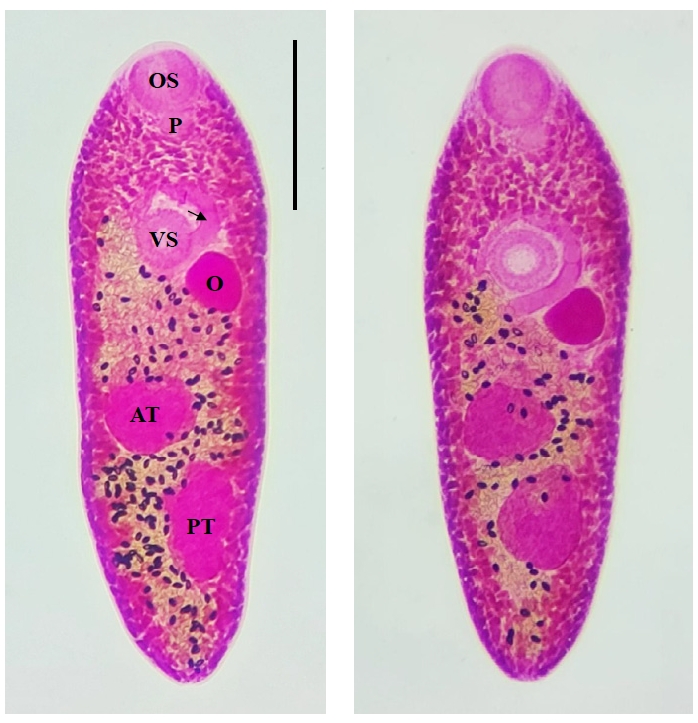
Fig. 1) were dorsoventrally flattened and elongated, 1,050–1,750 (1,610) long and 450–650 (548) in maximum width, which is in the ventral sucker (VS) and/or ovary level. The ratio of body width to body length 1:2.94 on average. The oral sucker (OS) was round, 155–210 (186) × 170–220 (192) in size. Pharynx muscular, oval shape and 55–80 (68) × 75–105 (88) in size. Esophagus absent and intestinal ceca immediately bifurcated at the posterior end of pharynx and then terminated at the posterior region of the body. VS round, slightly smaller than the OS (the ratio of OS to VS 1:0.93 on average), 140–205 (172) × 155–200 (177) in size and situated on the anterior 1/3 of body. The cirrus sac was reverse C-shaped, 200–420 (327) long and 45–70 (54) maximum wide, obliquely passing between the left bottom side of VS and the right upper side of ovary. The ovary was round or elliptical, located at the left bottom side of cirrus sac and leftly deviated from the median line, 110–185 (144) × 125–160 (151) in size. Testes round or elliptical, big, located at the posterior region of ovary, obliquely located and separated from each other by uterine coils. Anterior testis mostly round, 195–330 (246) × 165–290 (230) in size. Posterior testis long elliptical, 210–360 (282) × 155–275 (199) in size. Seminal receptacle was absent. The vitellaria were follicular and numerous mostly distributed to both lateral fields from the mid-level of OS to posterior end of body, and confluently distributed at anterior body between the mid-level of OS and VS level. Uterus reverse S-shape or ?-shape, mostly occupying from the right 2/3-level side or bottom side of VS to the posterior end. Eggs yellowish with an operculum, numerous, 28–33 (31) × 18–20 (19) in size.
This study was only performed with the intestines resected from individual field mouse transported from Department of Microbiology, Jeollabuk-do Institute of Health and Environment Research. The institutional animal care and use committee was not responsible in the institution of corresponding author, Gyeongsang National University, College of Medicine. However, the ethical approval in institutional animal care and use committee was obtained on the collection, euthanasia and necropsy of field mice individuals in the original project entitled “Study on the pathogenic characterization of rodent-borne diseases by climatic changes.”
The striped field mouse,
A. agrarius, is the most widely and abundantly distributed in rural areas of Korea. Therefore, the helminthic infections were most frequently examined with this mouse species (
Tables 2,
3) [
6,
8,
11,
13,
16-
18]. Seo et al. [
6] examined the helminthic infection with 221
A. agrarius from 5 local areas of Gangwon-do and Gyeonggi-do. Chai et al. [
13], Chai et al. [
14], and Chai et al. [
15] examined a total of 1,366 striped field mice from 3 regions of northern Gyeonggi-do. A helminthic survey was performed with 43
A. agrarius (together with 11
A. peninsulae) from Yanggu-gun and Inje-gun in northern Gangwon-do [
16]. A survey on the infection status of helminths was performed with 133 and 103 striped field mice from Hapcheon-gun, Gyeongsangnam-do and Gurye-gun, Jeollanam-do [
17]. Lee et al. [
18] surveyed the infections of intestinal helminths with 57
A. agrarius (together with 26
A. peninsulae), from mountainous regions and agricultural fields of Gangwon-do and Chungcheongnam-do. In this study, we examined 78 small intestines of striped field mice captured in 7 local areas of Jeollabuk-do. The number of mice examined were much different by the survey localities, from 5 (Gochang-gun) to 21 mice (Muju-gun). Therefore, the prevalence of ZIH is more or less meaningless by survey localities, but the overall trend of ZIH infections is obviously revealed in striped field mice from Jeollabuk-do by this study.
Since Park [
5] first reported
I. hortensis as a rodent trematode in 1938, more than 11 trematode species were described and listed from rodent hosts in Korea [
6-
11,
13-
17,
19]. Seo et al. [
6] described the infections of 5 trematode species, i.e.,
I. hortensis,
Echinostoma cinetorchis,
Euparyphium murinum,
P. muris, and
N. seoulense, from rodent hosts. Seo et al. [
9] found 6 trematode species, i.e.,
Clonorchis sinensis,
Metagonimus yokogawai,
E. cinetorchis,
I. hortensis,
P. muris, and
N. seoulense, from 170 house rats. Lee et al. [
10] also reported 6 trematode species, i.e.,
I. hortensis,
E. cinetorchis,
Echinostoma revolutum,
Echinoparyphium recurvatum,
P. muris, and
N. seoulense, in 2 house rats from Yangyang-gun, Gangwon-do. Only 1 specimen of
Echinochasmus japonicus was detected from a striped field mouse by Yong et al. [
11]. Chai et al. [
13], Chai et al. [
14], and Chai et al. [
15] detected
P. muris,
N. seoulense, and 4 species of echinostomes (
I. hortensis,
E. cinetorchis,
E. japonicus, and
E. murinum) in the field mice from the northern Gyeonggi-do. Sohn et al. [
17] reported 4 species of trematodes,
I. hortensis,
E. cinetorchis,
P. muris, and
Brachylaima sp., recovered in the small intestines of
A. agrarius from Hapcheon-gun, Gyeongsangnam-do and Gurye-gun, Jeollanam-do. Recently, Kim et al. [
19] described a case of
Fasciola sp. infection in a wild nutria from the wetland around Nakdong-gang (gang means river). From the previous studies, we can know that 3 trematode species,
I. hortensis,
E. cinetorchis, and
P. muris, were commonly detected from rodent hosts in Korea.
In this study, only 1 trematode species,
P. muris, was recovered in 7 (9.0%) out of 78 striped field mice examined, and the infection intensity was 1–6 (3.3 on average) per mouse infected. In Sohn et al. [
17], the prevalence of this trematode was 19.5% and 8.7% in 133 and 103 striped field mice from Hapcheon-gun, Gyeongsangnam-do and Gurye-gun, Jeollanam-do, Korea. Their infection intensities were 1–71 (9.9) and 1–3 (1.9) in mice from Hapcheon-gun and Gurye-gun. Chai et al. [
13] detected 1–263 (22.9 on average)
P. muris from 72 (5.3%) out of 1,366 striped field mice from 3 regions, Paju-si, Yeoncheon-gun and Pocheon-si, of northern Gyeonggi-do. Lee et al. [
16] recovered these trematodes from 2 (4.7%) out of 43
A. agrarius caught from Yanggu-gun and Inje-gun in northern Gangwon-do. Lee et al. [
10] found 2
P. muris in a house rat from Yangyang-gun, Gangwon-do. Seo et al. [
9] detected 2
P. muris from 2 (1.2%) out of 170 house rats,
Rattus spp. caught in 13 localities of Korea. Seo et al. [
6] collected a total of 33
P. muris from 5 (2.3%) out of 221
A. agrarius and 1 (12.5%) of 8
Rattus alexandrinus (
Table 2) [
6,
13,
16,
17]. When we analyze the infection status of
P. muris reported in previous studies and in the present study, we can presume that the striped field mouse,
A. agrarius, is to be the most suitable rodent host of this trematode. Additionally, the prevalence of this trematode was more or less higher in mice from Hapcheon-gun, Gyeongsangnam-do, but the infection intensity was much higher in mice from northern Gyeonggi-do [
13,
17]. However, it is questionable that how the field mice get infected with these trematodes. The dragonflies have been commonly known as the second intermediate hosts and the infection source of this trematode in definitive hosts like bats [
20]. How can field mice readily catch and consume dragonflies?
We found that the morphological descriptions of
P. muris were made with the dorsal-side view in previous studies [
6,
16]. Therefore, we described the ventral-side view of
P. muris adults recovered in this study. This species of trematode is morphologically characterized by a small and/or medium sized, an OS slightly larger than VS, a left-deviated ovary, 2 tandem testes, and follicular vitellaria mainly distributed to both lateral fields from the mid-level of OS to posterior end of body. This species distinctly differs from other 3 species, i.e.,
P. koreanus,
P. rhinolophi, and
P. magnacotylus, which were described from Korean bats, in the body size and distribution of vitellaria.
A total of 5 species of tapeworms, i.e.,
Cysticercus fasciolaris (metacestode of
Hydatigera taeniaeformis),
H. diminuta,
H. nana,
Raillietina coreensis, and
Paranoplocephala sp., have been reported from rodent hosts in Korea [
3,
4,
8]. Since Nakamura and Kobayashi [
3] first reported
C. fasciolaris as the rodent tapeworm in Korea, this larval cestode was frequently detected in the liver of rodent hosts [
7,
8,
11,
12]. Especially, Seo et al. [
7] found
C. fasciolaris in 65 (20.0%) out of 325 brown rats,
R. norvegicus, captured in Seoul. Seo et al. [
8] detected
C. fasciolaris in 2 (6.1%) out of 33 brown rats. Yong et al. [
11] and Seong et al. [
12] also reported the infections of this larval cestode in Korea. Since Ogura [
4] described
H. diminuta and
H. nana from rodent hosts of Korea, many Korean workers reported the infection status of intestinal rodent tapeworms in Korea (
Table 3) [
8,
11,
16-
18]. In this study, 2 tapeworm species,
H. diminuta and
H. nana, were found in 4 (5.1%) and 14 (17.9%) out of 78
A. agrarius caught from 7 local sites of Jeollabuk-do. From the previous and present studies, we can know that 3 tapeworm species,
C. fasciolaris,
H. diminuta, and
H. nana, are frequently found from the rodent hosts of Korea [
3,
4,
8,
11,
12,
16-
18]. The larval tapeworm,
C. fasciolaris, inhabited in the liver of rodent hosts was not found in recent surveys on the intestinal helminth infections including the present study [
16-
18]. Two species of tapeworm,
H. nana and
H. diminuta, were widely distributed and zoonotic intestinal cestodes of rodents in Korea. They can be distinguished by their unique morphologies, i.e., the size of whole strobila, scolex, mature and gravid proglottids, and eggs, even in mixed infections in the small intestines of field mouse.
Conclusively, the infection trend of ZIH is partly revealed with a survey of 78 striped field mice, A. agrarius, from 7 local sites of Jeollabuk-do, Korea by the present study. Some species of helminths belong to the nematode, trematode and cestode parasitic in the rodent hosts can be the zoonotic pathogens. Especially, 4 trematode species, E. cinetorchis, I. hortensis, P. muris, and N. seoulense, and 2 cestode species, H. nana and H. diminuta, also infect humans. Wild rodents can act as the reservoir hosts of these ZIH in Korea. Accordingly, the surveillance on the ZIH infections in wild rodents should be continued in the future.
Notes
-
Author contributions
Conceptualization: Sohn WM. Data curation: Sohn WM, Na BK, Kim CH. Formal analysis: Sohn WM, Na BK. Investigation: Sohn WM, Na BK, Kim CH. Methodology: Sohn WM, Na BK, Kim CH. Project administration: Sohn WM, Kim CH. Supervision: Sohn WM. Validation: Sohn WM, Na BK. Visualization: Sohn WM. Writing – original draft: Sohn WM. Writing – review & editing: Sohn WM, Na BK.
-
Conflict of interest
Woon-Mok Sohn and Byoung-Kuk Na serve as editors of Parasites, Hosts and Diseases but had no involvement in the decision to publish this article. No other potential conflicts of interest relevant to this study were reported.
Fig. 1.Ventral views of 2 Plagiorchis muris detected in a striped field mouse, Apodemus agrarius, from a survey site of Namwon-si, Jeollabuk-do, Korea. OS, oral sucker; P, pharynx; VS, ventral sucker; O, ovary; AT, anterior testis; PT, posterior testis. Arrow indicates cirrus sac. Scale bar=500 μm.
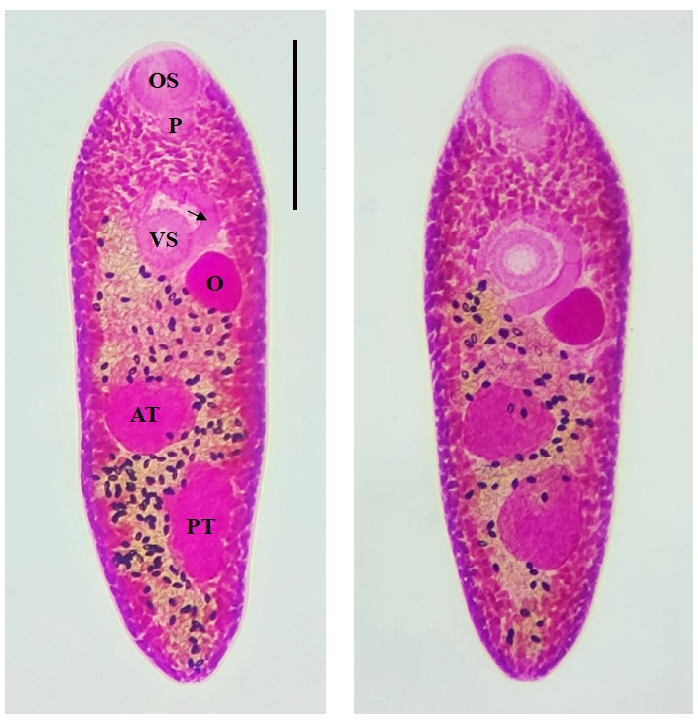
Table 1.Results of the worm recovery in the small intestines of striped field mice from 7 localities of Jeollabuk-do, Korea
Table 1.
|
Helminth |
No. (%) of mice infected with helminth by localitiesa
|
|
Sunchang (n=7) |
Wanju (n=12) |
Imsil (n=11) |
Muju (n=21) |
Jeonju (n=9) |
Namwon (n=13) |
Gochang (n=5) |
Total (n=78) |
|
Trematoda |
Plagiorchis muris
|
2 (28.6) |
0 |
0 |
1 (4.8) |
3 (33.3) |
1 (7.7) |
0 |
7 (9.0) |
|
Cestoda |
Hymenolepis nana
|
1 (14.3) |
0 |
3 (27.3) |
1 (4.8) |
3 (33.3) |
5 (38.5) |
1 (20.0) |
14 (17.9) |
|
Hymenolepis diminuta
|
0 |
1 (8.3) |
2 (18.2) |
0 |
0 |
1 (7.7) |
0 |
4 (5.1) |
Table 2.Comparison of Plagiorchis muris recovery in the striped field mice, Apodemus agrarius, by authors in Korea
Table 2.
|
Items |
Present study (2026) |
Sohn et al. (2014) [17]a
|
Lee et al. (2013) [16] |
Chai et al. (2007) [13] |
Seo et al. (1964) [6] |
|
No. of mice examined |
78 |
236 |
43 |
1,366 |
221 |
|
No. (%) of mice infected |
7 (9.0) |
35 (14.8) |
2 (4.7) |
72 (5.3) |
5 (2.3) |
|
No. (average) of worms recovered |
1–6 (3.3) |
1–71 (7.8) |
- (1.0) |
1–263 (22.9) |
- (5.5)b
|
|
Survey localities |
Seven local sites in Jeonbuk |
Hapcheon in Gyeongnam, Gurye in Jeonnam |
Yanggu-gun, Inje-gun in Gangwon |
Paju-si, Yeoncheon-gun, Pocheon-si in Gyeonggi |
Cheorwon-gun in Gangwon, Pocheon-si in Gyeonggi |
Table 3.Prevalence
a of intestinal tapeworms in the striped field mice,
Apodemus agrarius, by authors in Korea
Table 3.
|
Items |
Present study (2026) |
Lee et al. (2018) [18]b
|
Sohn et al. (2014) [17] |
Lee et al. (2013) [16]c
|
Yong et al. (1991) [11]d
|
Seo et al. (1968) [8]e
|
|
Hymenolepis nana
|
14/78 (17.9) |
- |
79/236 (33.5) |
4/43 (9.3) |
16/85 (18.8) |
10/219 (4.6) |
|
Hymenolepis diminuta
|
4/78 (5.1) |
9/57 (16.4) |
21/236 (8.9) |
12/43 (27.9) |
13/85 (15.2) |
7/219 (3.2) |
|
Raillietina coreensis
|
- |
- |
- |
- |
- |
2/219 (0.9) |
|
Paranoplocephala sp. |
- |
- |
- |
- |
- |
1/219 (0.5) |
|
Survey localities |
Seven local sites in Jeonbuk |
Wonju-si in Gangwon, Gongju-si in Chungnam |
Hapcheon in Gyeongnam, Gurye in Jeonnam |
Yanggu-gun, Inje-gun in Gangwon |
Goyang-si in Gyeonggi, Iksan-si in Jeonbuk |
Paju-si, Pocheon-si, Cheongpyeong-myeon in Gapyeong-gun, Gyeonggi Cheorwon, Gimhwa, Cheorwon-gun in Gangwon |
References
- 1. Chaisiri K, Chaeychomsri W, Siruntawineti J, et al. Diversity of gastrointestinal helminths among murid rodents from northern and northeastern Thailand. Southeast Asian J Trop Med Public Health 2012;43:21-8.
- 2. Rabiee MH, Mahmoudi A, Siahsarvie R, Kryštufek B, Mostafavi E. Rodent-borne diseases and their public health importance in Iran. PLoS Negl Trop Dis 2018;12:e0006256. https://doi.org/10.1371/journal.pntd.0006256
- 3. Nakamura K, Kobayashi S. Rat species in Chosen and their ecto- and endoparasites. J Chosen Med Assoc 1935;25:183-4.
- 4. Ogura K. Studies on the Hymenolepis nana in Korea. Chosen Igakkai Zasshi 1936;26:649-68.
- 5. Park JT. A rat trematode, Echinostoma hortense Asada, from Korea. Keijo J Med 1938;9:283-6.
- 6. Seo BS, Rim HJ, Lee CW. Studies on the parasitic helminths of Korea: I. Trematodes of rodents. Korean J Parasitol 1964;2:20-6. https://doi.org/10.3347/kjp.1964.2.1.20
- 7. Seo BS, Rim HJ, Lee CW, Yoon JS. Studies on the parasitic helminths of Korea: II. Parasites of the rat, Rattus norvegicus Erxl. in Seoul, with the description of Capillaria hepatica (Bancroft, 1893) Travassos, 1915. Korean J Parasitol 1964;2:55-62. https://doi.org/10.3347/kjp.1964.2.1.55
- 8. Seo BS, Rim HJ, Yoon JJ, Koo BY, Hong NT. Studies on the parasitic helminths of Korea: III. Nematodes and cestodes of rodents. Korean J Parasitol 1968;6:123-31. https://doi.org/10.3347/kjp.1968.6.3.123
- 9. Seo BS, Cho SY, Hong ST, Hong SJ, Lee SH. Studies on parasitic helminths of Korea: V. Survey on intestinal trematodes of house rats. Korean J Parasitol 1981;19:131-6. https://doi.org/10.3347/kjp.1981.19.2.131
- 10. Lee SH, Sohn WM, Chai JY. Echinostoma revolutum and Echinoparyphium recurvatum recovered from house rats in Yangyang-gun, Kangwon-do. Korean J Parasitol 1990;28:235-40. https://doi.org/10.3347/kjp.1990.28.4.235
- 11. Yong TS, Chung KH, Ree HI. Infection status of parasites of field rodents in Korea. Yonsei Rep Trop Med 1991;22:55-9.
- 12. Seong JK, Huh S, Lee JS, Oh YS. Helminths in Rattus norvegicus captured in Chunchon, Korea. Korean J Parasitol 1995;33:235-7. https://doi.org/10.3347/kjp.1995.33.3.235
- 13. Chai JY, Park JH, Guk SM, et al. Plagiorchis muris infection in Apodemus agrarius from northern Gyeonggi-do (province) near the demilitarized zone. Korean J Parasitol 2007;45:153-6. https://doi.org/10.3347/kjp.2007.45.2.153
- 14. Chai JY, Park JH, Guk SM, et al. Apodemus agrarius as a new definitive host for Neodiplostomum seoulense. Korean J Parasitol 2007;45:157-61. https://doi.org/10.3347/kjp.2007.45.2.157
- 15. Chai JY, Park JH, Jung BK, et al. Echinostome infections in the striped-field mouse, Apodemus agrarius, and the Ussuri white-toothed shrew, Crocidura lasiura, caught near the demilitarized zone, Gyeonggi-do (Province), Republic of Korea. Korean J Parasitol 2009;47:311-4. https://doi.org/10.3347/kjp.2009.47.3.311
- 16. Lee YI, Pyeon HJ, Seo M. Intestinal parasites among wild rodents in northern Gangwon-do, Korea. Korean J Parasitol 2013;51:603-6. https://doi.org/10.3347/kjp.2013.51.5.603
- 17. Sohn WM, Na BK, Song HJ, Kim CM, Nam GJ. Intestinal helminthic infections in striped field mice, Apodemus agrarius, from two southern regions of Korea. Korean J Parasitol 2014;52:419-23. https://doi.org/10.3347/kjp.2014.52.4.419
- 18. Lee JH, Gong S, Park YC, et al. Infections of intestinal helminth at two species of field mice, Apodemus agrarius and A. peninsulae, in Gangwon-do and Chungcheongnam-do, Korea. Korean J Parasitol 2018;56:301-4. https://doi.org/10.3347/kjp.2018.56.3.301
- 19. Kim HS, Kong JY, Kim JH, Yeon SC, Hong IH. A case of fascioliasis in a wild nutria, Myocastor coypus, in Republic of Korea. Korean J Parasitol 2018;56:375-8. https://doi.org/10.3347/kjp.2018.56.4.375
- 20. Hong SJ, Woo HC, Lee SU, Huh S. Infection status of dragonflies with Plagiorchis muris metacercariae in Korea. Korean J Parasitol 1999;37:65-70. https://doi.org/10.3347/kjp.1999.37.2.65